Friday, 20 November 2015

RRS James Clark Ross

We departed from the Falklands on the evening of 12th November. Life on board varies for the staff as not only is there the ships’ crew but also the teams being dropped off at the bases and scientists working on the RRS James Clark Ross, otherwise known as the JCR, itself. These latter utilise the JCR’s role as a research vessel in order to collect a whole range of data on the marine environment to increase our understanding of life in the Southern Ocean.

Meals were regularly supplied at 7:20, 12:00 and 18:30 each day in the galley and the majority of persons on board lived in the same type of quarters. Shared rooms of either 2, 3 or 4 people with a small en suite and enough space for the voyage.
2 bed bunk on the JCR
For those of us being dropped off at bases we had little work to do en route, except the daily rota of duties including hoovering alleyways, scrubbing communal toilets or cleaning the socialising areas. A lot of our time was spent wobbling along the corridors, trying to keep our footing and not getting seasick! But when we were able to do so we spent our time socialising in the lounge/bar room, playing cards, darts (interesting with a swaying target!) or board games, occupying ourselves with the book library or making full use of the views from the ship.

Bar and lounge area on the JCR
As ecologists without a doubt the best way to pass time was the views as they offered the chance of seeing the wildlife passing by. Whether it be from Monkey Island (deck on top of the ship) or right on the bow the views were incredible. Particularly as it meant getting close to the birds as they flew past.

Southern Giant Petrel
Left to right: Snow Petrel and Cape Petrel
The highlight of life on board ship was the approach to Signy Island, in the South Orkneys just off of the Antarctic continent, where we had to travel through the pack ice; pushing it out of the way to get through to the base. The sound of the ice crunching against the ship as the floor shudders beneath your feet is quite an interesting experience. No photos can do this landscape justice; it was just awe-inspiring to be amongst the ice.

ICE!!
Of course, as we got further south and closer to land there were more penguins accompanying our ship. In particular the Chinstrap Penguins were a regular sight just off the ship, whilst further in the distance some Adelie Penguins could be seen crossing the ice and diving into the water. It wasn’t just penguins either, with a few Weddell and Crabeater Seals lounging on the ice!

Top: Adelie Penguins jumping in the water - Bottom: Chinstrap Penguin swimming by the ship
Top: Weddell Seal - Bottom: Crabeater Seal
 Unfortunately not all the wildlife was quite so photogenic. Two species I had really been looking forward to seeing were the Antarctic Prions (small relatives of the petrels) and any type of whale. The great thing was we saw both!! Absolutely incredible! But taking photos of small, fast moving birds or distant, brief and elusive mammals isn’t the easiest so I’m afraid this was the best I could do.

Left to right: Unknown whale species blowing and Antarctic Prion
All the more reason to keep on wildlife watching and practising with the camera, which I will be sure to do between Signy and South Georgia; where the bases of King Edward Point and Bird Island are.

Monday, 16 November 2015

Travelling South!

After two months of training, and a lot of anticipation, on the 5th November I finally began my journey south. Starting in Cambridge we had a coach to Heathrow and an 11 hour flight overnight to Sao Paulo, Brazil just to get into the Southern Hemisphere.

With just a few hours between connections we unfortunately didn’t get to see anything but an overcast airport in Sao Paulo. But as our next flight took us across to Santiago, Chile for the night we were able to see a little bit of that city…. and have a final meal out, at a very nice steak house!

From Santiago we flew further south on the morning of the 7th to Punta Arenas and from there to the Falklands finally arriving a little after lunchtime. From the airport we were taken to the harbour in Stanley where our vessel was waiting, the RRS James Clark Ross.
The RRS James Clark Ross
Throughout the journey I was reading South! by Sir Ernest Shackleton. A description of his expedition meant to land a team for the first ever trans-Antarctic crossing. Unfortunately their ship, the Endurance, was trapped and crushed by ice leaving Shackleton and his crew to survive a polar winter by camping! What followed was an escape from the Antarctic, a sailing across 600 miles of open water to South Georgia and a winter crossing of that island (the first ever!) to find rescue. An interesting book to choose when going south myself, but definitely a recommended read.

After a few days of travelling it was brilliant to finally arrive on the ship and start to prepare for the real travelling! But as we had a couple of days in the harbour it also meant I got my first opportunity to see some Southern Hemisphere species.

In the harbour I saw my first Wandering Albatross and Giant Petrel. But as all these species will be major focuses of my updates from Bird Island I will say nothing more on them now, other than........ WOW!!!

The Falklands have a number of other very cool species to see though, and it was great to get out and see the likes of: Turkey Vulture, Magellanic Oystercatcher, Black-throated (Canary-winged) Finch, (Falklands) Grass Wren, Long-tailed Meadowlark, Steamer Duck, Crested Teal, Upland Goose, Kelp Goose, Two-banded Plover, Rufous-chested Dotterel, Baird’s Sandpiper, Rock Shag, Blue-eyed Shag, Black-crowned Night-heron, Kelp Gull and Dolphin Gull.
Left to right: Baird's Sandpiper, Two-banded Plover and Rufous-chested Dotterel
Left to right: Dolphin Gull, Black-crowned Night-heron and Rock Shag

Top left going clockwise: Turkey Vulture, Falklands Grass Wren, Black-throated Finch and Long-tailed Meadowlark
I also managed to see my first penguin on the Falklands, the Magellanic Penguin, which is actually a burrow nesting species which lay their eggs at this time of year. We managed to see a couple of them leaving the water and making their way up a beach to their burrows. It was very exciting to see my first wild penguins waddling up a beach and I can’t wait to spend the coming months working within the colonies of other penguin species on Bird Island.
Magellanic Penguin
In the same bay as the penguins there were also glimpses of Peale’s Dolphin, a pod of 4 individuals, showing their dorsal fins above the water. It is always amazing to see cetaceans and I hope to see a few more on our crossing, fingers crossed especially for a whale or two!

After our time in Stanley we actually moved to another part of the Falklands to refuel. From our new location there was a whole new coastline to investigate. Along this we saw many of the same species as before but also saw South American Terns and Gentoo Penguins for the first time (again more on the latter when I write future blogs from Bird Island).
South American Tern
But one of the highlights of this new location came on the morning of the 11th when we found my first wild King Penguin!! It actually came ashore as we were walking back to the ship the night before but in the morning we found it asleep and were able to get quite close, amazing!
King Penguin
After spending time with the King we continued along the beach and not only saw a Southern Sea Lion but also a pod of at least 7 Commerson’s Dolphins hunting and playing in the waves! These are tiny little dolphins and seeing them under the waves as they broke was outstanding.
Southern Sea Lion
Commerson's Dolphins
Spending this time with my first wildlife down south has really got me excited for what is to come and we left the Falklands on the 12th November to journey to the bases of Signy, King Edward Point and Bird Island. The real adventure begins now!

Monday, 5 October 2015

Alderney Wildlife Trust

Alderney is the third largest Channel Island (after Jersey and Guernsey) and is the closest one to the French coast. I started working with the Alderney Wildlife Trust in March 2013, initially on a one year placement that extended to 21 months due to how much I enjoyed it there.
Bottlenose dolphins off the bow of our tour boat
As the seabird ecologist (retitled Ramsar ecologist in 2014) it was my role to fulfil the ongoing management plan for Alderney’s Ramsar site. This role included so many aspects, from boat crewing and PhD student assistance to primary school education and media work. But it was the monitoring of multiple seabird species where most of my work was focused.
A view from within the gannet colony of Les Etacs
The logistics of monitoring multiple colonies on numerous offshore islets with limitations to personnel availability and sea/weather conditions is not easy, especially when considering the boat being used also had to be used as a tour boat for visitors. But the experience it gave me was ideal preparation for a job on Bird Island where numerous work streams will have to be well balanced to get the best data available.
Fulmar incubating an egg
I worked with numerous species on Alderney, including puffin, gannet, fulmar, ringed plover, common tern and shag (although unfortunately the razorbills were in a location that was impossible to monitor, much to my disappointment!). But there were a few work streams in particular that stood out for me in my time on Alderney:

LIVE
Views of puffins from Alderney's live camera (note the puffling just out the burrow in the middle of the third shot)
Alderney has live web cameras on their gannet and puffin colonies during the breeding season. These cameras and the ecological work around the species’ is the main factor constituting an educational program available to primary schools across the UK. This program, LIVE: Teaching Through Nature, was an amazing way to be able to show the wonders of nature to the next generation and hopefully inspire the next group of wildlife conservationists.

Lesser black-backed gulls
OK, let’s get this out the way first…. there is no such thing as a seagull!! Many species of gull live in the UK, the most commonly sighted one in coastal towns is the herring gull, whilst my personal favourite is the lesser black-backed gull. I spent a long time monitoring this species around Alderney, working with the Channel Island Bird Ringers to study them closely. Their foraging and migratory habits were fascinating aspects of their ecology and their breeding success has been very hit and miss in recent years. Finding out more about this species is something I am still getting involved in today.

Storm-petrel
Not as big as an albatross but just as impressive!
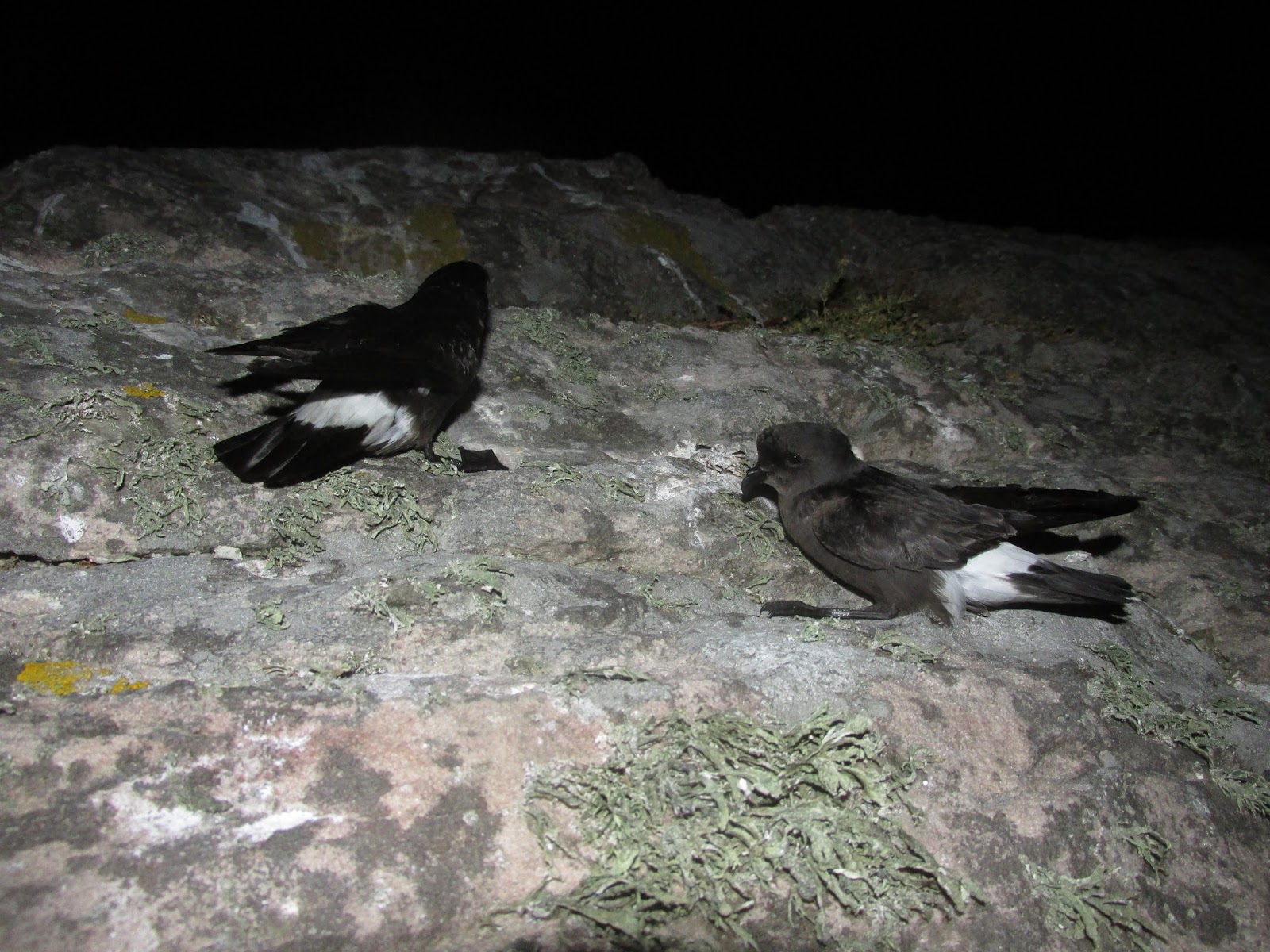
Storm-petrels are within the same family as larger petrels and albatross, but the European storm-petrel is just the size of a sparrow. As such, to avoid predators they only come to land at night to feed their chick whilst they spend the day far out to sea foraging for food on the water’s surface. As most seabird ecologists will attest to when you have these birds close-up they have a very unique and amazing smell! To get close-up to them we undertook ringing studies that have allowed population estimates that are more reliable and higher than any previously done around Alderney.

But most importantly to me I started dating my girlfriend, Nicci, during a storm-petrel survey in July 2014, so they will always be a special species.
Nicci looking out for seabirds around a gannet colony on Les Etacs
This blog is nowhere near in depth enough to fully describe how important Alderney was for my personal and professional development. Without my time there I would not have been ready for the job with BAS and I would recommend it to anyone looking at getting in to a similar career; so for more details on the Ramsar work in Alderney click here.
Sunset behind the Sister Rocks

Monday, 28 September 2015

Introduction

In April this year I accepted a post with the British Antarctic Survey to be their penguin and giant petrel Zoological Field Assistant on Bird Island, South Georgia (in the sub-Antarctic region). Throughout September and October I am undergoing all sorts of training in preparation for this role and will be flying out on the 4th November.
Soon I will get to see these guys in the wild!
As this is such an amazing job opportunity for a seabird ecologist I have decided to write this blog to show the amazing wildlife in the sub-Antarctic to anyone that wants to read about it. I will be in a location with limited internet access so blogs will be irregular but I will try and upload new ones whenever available.

Bird Island is an amazing location to be working at, and in my first on-island blogs I will be describing the journey there and the island itself. But for this introductory blog I thought it would be best to describe how I got here….. very briefly!!

I have always loved animals and wanted to work closely with them in my career. I decided the best way to do this would be to go into conservation work as it is vital to protect the natural world for the wellbeing of people and the planet. As such I studied for a BSc in Ecology, Economics and the Environment at the University of York. During my third year on this course I sat my first entirely marine based conservation module. The comparative lack of understanding and protection afforded to marine environments over terrestrial ones astounded me and I wanted to learn more, much more!
Moon jellyfish in the red sea
Therefore, I signed on for an MSc in Marine Environmental Management, again at York. However, having already committed to some voluntary work in Ecuador after my BSc finished I had to have a gap year before starting the MSc.
Most work in Ecuador involved cleaning cages and feeding the animals. But when a puma needs a lift after anesthetic who am I to refuse! :)
Working in animal rescue centres in Ecuador was a great experience but I had a lot of time before starting my studies again in York. So my tutor recommended I contact RSPB Bempton Cliffs who had been looking for summer volunteers monitoring their seabird colonies.
Cliff top views of seabirds from Bempton and nearby Flamborough are spectacular
In just two months at Bempton I realised how much fun it can be to work with seabirds, particularly as they are an excellent visual indicator of the health of the otherwise unseen marine environment; this makes them an ideal subject for research in to understanding marine environments and increasing the awareness of conservation issues around such locations.
Gannet flying at Bempton
During my MSc I developed an understanding of how conservation efforts are done in marine environments; including doing my final dissertation on work in Madagascar!
May not be a marine landscape (although there is water!), but a trip to Montagne d'Ambre is a must for all wildlife enthusiasts visiting Madagascar
Following the MSc and another four months at Bempton, I moved to Alderney to work with the Alderney Wildlife Trust and take on the day-to-day work involved in managing their Ramsar Site. My work in Alderney was vital to my acceptance as a scientist with BAS, so details of my time there will follow in the next blog.
Razorbill - my favourite :D
Before then a quick note on my name – RememberTheRazorbill. I developed a personal favourite in the razorbill during my time at Bempton Cliffs. Puffins are always the poster child of seabird work in the UK whilst gannets get a lot of attention due to their size and diving habits. Meanwhile guillemots and kittiwakes group together in such numbers that they are always well received. However, razorbills, being more spread out throughout a mixed seabird colony, can often be overlooked and so I made sure to always point them out to visitors to the site and they quickly became my favourite because of it. Ever since I have made sure that razorbills get included wherever I can!