Showing posts with label RRS James Clark Ross. Show all posts

Monday, 23 November 2015

Humpback Whales

On route from Signy to South Georgia we again passed through the ice. But it was once we reached the open water that we got the exceptional wildlife sighting of this part of the journey – Humpback Whales! I have never seen whales before coming south and I was very excited at just distant and brief glimpses of what we think were Antarctic Minke Whales on the way down to Signy. But when we came across a pod of Humpback Whales that came right alongside the ship the whale watching became absolutely outstanding. Here are the best pictures I managed to get amongst the excitement:
They came even closer to the ship than this!
Sights of the flukes were few, but brilliant.
Blowing out water was a sure sign that a whale had arrived!
3 in one frame, but there were a minimum of 6, including a calf!
Wildlife watching at its finest.
Humpback Whales - Spectacular!!

Sunday, 22 November 2015

Signy


We arrived at Signy base at lunchtime on the 16th November, however conditions in the bay outside the base were far from ideal with ice in the water still and heavy winds blowing. As such the Signy team just did a quick reconnaissance to establish the condition of the base before we began work on the 17th. The weather was much nicer on the 17th and the views of the mountainous Signy and the glaciers on neighbouring Coronation Island were incredible, just when I think the views of the ice on the way here were spectacular these South Orkney Islands upped the level!
Top: Signy - Bottom: Coronation Island
We were split into groups, some going ashore to unload equipment and dig the snow that had accumulated over winter (Signy is only manned during the summer months) out and away from the base. The cargo and people were transferred by a tender with ribs accompanying for safety.
Getting the cargo and people to Signy
I was in the group that initially stayed on the JCR in order to load the equipment on to the tender and reorganise and tidy our cargo hold afterwards. The perk of this job was being entertained by a Brown Skua which followed us around deck. I must say that wild animals getting too accustomed to people is not a good thing, and this Skua certainly wasn’t encouraged by us to be on the deck – don’t feed wild animals! But as this one was sticking around we had to get a few photos; I certainly won’t be expecting the Skuas on Bird Island to be this placid when I see them!
Skua on the JCR


The pictures so far may be a bit misleading, the sunshine around Signy isn’t exactly common and we were reminded of that the following day. The weather reverted to what it was when we first arrived and we had to spend the day aboard the JCR hoping for a window in which to send people and the remaining equipment and stores over to the base again. But with the high winds and ice back in the bay outside the base (the base is behind the low rocks in middle of the picture below) we were left waiting a while.
Grey skies, high winds and ice return to Signy


After a false alarm late in the afternoon on the 18th – we got all kitted up and waited for the tender but the winds picked up and after half an hour we had to give up – we made our final trip to Signy first thing the following morning. This time I joined the shore team to complete the final cargo unloading and storing. Most of it was food, it had to be stored well and most importantly all the fresh food has to be checked through for any flora and fauna that may have been within; biosecurity is a major factor of protecting small islands with their own unique landscape and happily nothing was brought in on the food.
Cargo being moved by skidoo and sledge and then stored
The base is on Signy primarily to continue work with the Adelie Penguin colony; unfortunately we didn’t have time to go and see them but Stacey Adlard will be running the surveys this summer for the 5th year in a row (after she also did 2.5 years on Bird Island). It was good to talk to someone so experienced and learn about the work from someone else who has been through it all before. Alongside Stacey’s work there are visiting scientists at Signy this year, exchanging a few times through the season. This rotation of scientists is sometimes done on the islands in order to allow experts to collect a range of different data, that otherwise wouldn’t be collected as part of the regular monitoring projects, in order to better understand and protect the environment. I’m very glad to have had an opportunity to see another BAS base, one that is quite different in surroundings to what I will have on Bird Island, and Signy certainly was a spectacle.
View of Signy from the tender and view from Signy of the frozen bay
But now, with all the stores equipped and all the power confirmed to be running and stable it was time for us to leave the Signy team to their work for the summer and head to our next stop; South Georgia.
Goodbye from the Signy team! Have a great season!


Friday, 20 November 2015

RRS James Clark Ross

We departed from the Falklands on the evening of 12th November. Life on board varies for the staff as not only is there the ships’ crew but also the teams being dropped off at the bases and scientists working on the RRS James Clark Ross, otherwise known as the JCR, itself. These latter utilise the JCR’s role as a research vessel in order to collect a whole range of data on the marine environment to increase our understanding of life in the Southern Ocean.

Meals were regularly supplied at 7:20, 12:00 and 18:30 each day in the galley and the majority of persons on board lived in the same type of quarters. Shared rooms of either 2, 3 or 4 people with a small en suite and enough space for the voyage.
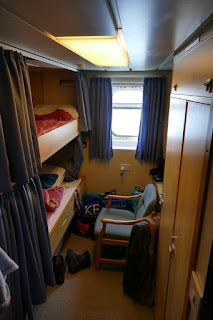
2 bed bunk on the JCR
For those of us being dropped off at bases we had little work to do en route, except the daily rota of duties including hoovering alleyways, scrubbing communal toilets or cleaning the socialising areas. A lot of our time was spent wobbling along the corridors, trying to keep our footing and not getting seasick! But when we were able to do so we spent our time socialising in the lounge/bar room, playing cards, darts (interesting with a swaying target!) or board games, occupying ourselves with the book library or making full use of the views from the ship.

Bar and lounge area on the JCR
As ecologists without a doubt the best way to pass time was the views as they offered the chance of seeing the wildlife passing by. Whether it be from Monkey Island (deck on top of the ship) or right on the bow the views were incredible. Particularly as it meant getting close to the birds as they flew past.

Southern Giant Petrel
Left to right: Snow Petrel and Cape Petrel
The highlight of life on board ship was the approach to Signy Island, in the South Orkneys just off of the Antarctic continent, where we had to travel through the pack ice; pushing it out of the way to get through to the base. The sound of the ice crunching against the ship as the floor shudders beneath your feet is quite an interesting experience. No photos can do this landscape justice; it was just awe-inspiring to be amongst the ice.

ICE!!
Of course, as we got further south and closer to land there were more penguins accompanying our ship. In particular the Chinstrap Penguins were a regular sight just off the ship, whilst further in the distance some Adelie Penguins could be seen crossing the ice and diving into the water. It wasn’t just penguins either, with a few Weddell and Crabeater Seals lounging on the ice!

Top: Adelie Penguins jumping in the water - Bottom: Chinstrap Penguin swimming by the ship
Top: Weddell Seal - Bottom: Crabeater Seal
 Unfortunately not all the wildlife was quite so photogenic. Two species I had really been looking forward to seeing were the Antarctic Prions (small relatives of the petrels) and any type of whale. The great thing was we saw both!! Absolutely incredible! But taking photos of small, fast moving birds or distant, brief and elusive mammals isn’t the easiest so I’m afraid this was the best I could do.

Left to right: Unknown whale species blowing and Antarctic Prion
All the more reason to keep on wildlife watching and practising with the camera, which I will be sure to do between Signy and South Georgia; where the bases of King Edward Point and Bird Island are.