Saturday, 9 July 2016

Midwinter Celebrations

Previously I have described a regular week for life on BI in the winter months. But at the end of June we had a special week of celebrations for midwinter! Whilst we do celebrate Christmas and new years down south they come at a time when our field work is much more intense. However, midwinter arrives when most of our work is in the lab or office so we can take a bit more time to enjoy the holidays.
The distinguished 'gentleman's' club out in full force for the holidays.
Throughout the week there were various celebrations, from doing our fieldwork dressed like some of the first scientists to come south to days spent watching films or doing craft works and games on base. We began the week with an indoor beach party and ended with a pub crawl where each person decorated a different room of the base to look like a different type of pub.
What's a beach party without some frisbee.
Throughout the weeks 'holiday' we still had to complete our fieldwork which meant checking the wanal chicks, counting pintails and looking for leopard seals. Each one of these was done by taking it turns and more often than not carrying out the surveys together and taking the time to enjoy the season.
Looking for leps just outside base with pastries and a mug of 'tea'.
One of the highlights of the week was our midwinter games. We have to get quite creative down here when conjuring up different things to do and so we held the inaugural curling championships. Devising ways to make the 'stones' (coloured ice blocks) was fun and the ice in the bay outside of base made the perfect rink to slide them on.
The Olympians arrive at the stage.
The curling 'stones' (coloured ice and pan lids) worked very well!
Besides curling we also took part in welly-wanging and bodger throwing, whilst between events we decided to make full use of the ice and see how many different ways we could slide around and propel ourselves across the ice!
Getting traction on ice was interesting for the throwing events.
Ice, ice baby!
Of course the main celebration was midwinter's day itself. The day kicked off with the traditional breakfast prepared by the station leader, so Lucy made an amazing meal for us all to wake up to.
Breakfast time.
It wouldn't be a celebration without a special drink!
After we all tidied away the day was spent preparing for the dinner itself. With Lucy doing starters, Ian and I preparing the mains and James on desserts we were all busy in the kitchen for large parts of the day, working together to put together a meal to remember. By the time all the food was prepared and ready for the oven it was getting close to the evening and so we all got ready.
The whole team looking great!
We usually eat at around 8pm but on this occasion there was so much to prepare and eat that we actually started at a more standard 6pm. The food was absolutely amazing and everyone certainly felt full afterwards! In fact the leftovers lasted us the next few days as well!
An amazing midwinter meal.
Between courses we also continued the midwinter tradition of presents! Each year the wintering team draw names from a hat to see who we will be making a gift for. Then we take it in turns in the workshop to create some brilliant projects that we can then give on the day. As it happens this year Ian and James drew each other whilst Lucy and I exchanged gifts.
Opening our presents.
The quality was very high and we were all very much excited and thrilled to get and give our gifts. It was great to see people have similar ideas as well in the end as James and Ian exchanged boxes with BI motifs whilst Lucy and I gave each other bird themed wall mounted gifts. I was very happy that Lucy really liked her wanal coat rack whilst my pingu barometer, wanal thermometer and BI clock set is absolutely amazing!
Birders are always happy with bird gifts, especially when they are this awesome!
After the meal we all sat down to listen to the midwinter broadcast. A BBC worldwide radio show that gave special mention to the teams working in Antarctica and played our specific song requests. ELO's Mr. Blue Sky was our ironic choice!
Listening to the radio broadcast.
Of course, after the meal, presents and radio show the evening didn't end there. After starting off the evening so smart we ended up dancing for about 5 hours and fully enjoying our main day of celebrations down south.
And we started the evening looking so smart!
Even our teddies - Polar and Bear - enjoyed midwinter!
After a day of celebrating midwinter and a week of events and games - and of course continuing fieldwork - it was time to get back to full-time work. For me this meant a lot of labwork and a lot of report writing. But that doesn't mean the craziness of BI stopped. A week after midwinter we were introduced to our alter egos! Captain Yorkshire, SuperSpud, The Poker and Mothman and Robin (Hood) are now here to protect BI and all its wildlife!
Isolated on an Antarctic island for 7 months with no other people around, we aren't going crazy! Honest! How could we go crazy with these intrepid super heroes here to look after us all!

Thursday, 9 June 2016

A Ferocious Predator

When we had the southern right whale so close in to the island just a couple of nights ago I thought that would be the pinnacle of wildlife sights for some time to come. But just a couple of days later and we witnessed something very different but equally exciting - a leopard seal tearing apart its fur seal prey!
"My, what big teeth you have!"
The leps, which we have come to call leprasaurus' (for no apparent reason!), thrash their prey about in order to rip chunks off to eat. When it is the first time I have seen such a kill (after missing a few earlier in the season) and it is just 10 metres in front of us it certainly rivals the whale for a pre-dinner spectacle!
Mmmmmm.... I wonder if someone has got a photo!?

The lep holding its prey in the water
The kelp got in the way at times


A very powerful performance!

Tuesday, 7 June 2016

Evening with a Whale!

Before coming south I had never seen whales before and a sighting of humpbacks from the ship totally smashed that with some amazing views. But since then sightings have been much rarer and more like you would expect, stood on a high point of Bird Island with just distant views of a whale or two poking above the water. I never thought I would get a better view of any whales than I did of the humpbacks from the ship and I certainly never expected to see any so close again whilst on land!...

....until last night that was! Whilst getting dinner ready I heard a call on the radio from James, he had seen a whale just offshore. Jerry, Ian and I all rushed out and got to the rocks at the mouth of the bay just outside base. We certainly weren't disappointed! There in front of us, at times as little as 15-20 metres away was a stunning sight - a Southern Right Whale feeding!!! This little island gets more amazing every day!
As close to a whale as I am ever likely to get on land!
The usual view is just of a back
But we got some amazing views of its head as well!
Absolutely stunning!!

Monday, 6 June 2016

A Week in Winter

Now that the molly chicks have fledged and sweeps for dead chicks completed for each colony the amount of wildlife I have to monitor has greatly reduced. In fact most of the geeps have fledged as well with just one final southern chick yet to go.
Dead chick sweeps allow us to find any chicks that didn't make it so that we get an accurate count of productivity. Driving wind and ice on the ground makes it difficult and quite laborious though! (Photo courtesy of Jerry).
The last chick of my field season!!
But despite the lack of mollies and geeps to keep me entertained there are still plenty of things to be getting on with for work. Most of it is office or lab based work but there are some species still around that need surveying through winter. So here is what happens in a typical week for winter on BI.

Monday

On Monday I completed the geep work for the year by typing the final results into our databases. Whilst there is still one chick left I could upload all the data and just adjust for the final chick when it does fledge. Our online databases link directly back to BAS Cambridge where our managers can review the years’ data.
A database, a graph and a spreadsheet open at once - yep, I am a scientist! :)
Of course it is difficult to stay inside all day, even when we are firmly in the grip of winter, as there is so much wildlife still around. So I spent a short time in the afternoon just out in front of base with some kelp gulls and Antarctic terns feeding amongst the kelp.
Kelp gulls, adults and fledglings
Getting photos of these quick flyers is not easy! Especially when they are fishing in a snow flurry.
Tuesday

In just a few weeks time we will be celebrating midwinter down south. This is a big celebration each year, partly because we are generally too busy around Christmas to get the full holiday spirit going (although Christmas was a lot of fun!) and partly because there are a few events that bring all bases on the continent together at this time – more on all that in blogs around midwinter. But what we do also have is a Secret Santa type arrangement where we all make a gift for someone else on base to open at midwinter. This is a great reason to fully utilise our workshop and get busy with some woodcraft!
Jerry and I working away on our projects (photo courtesy of Ian).
After putting some final touches to my midwinter gift it was time to get in to the lab and begin some identification work. The krill, squid beaks and otoliths (fish ear bones) collected from macaroni penguin and geep diet samples through the summer now have to be measured to identify sex, life stage (krill only) and species (squid and fish). By doing a few hours a day a few days a week the lab work is completed in plenty of time for the final season reports (in August) without us getting stuck in there for too long at any one time – staring through a microscope at tiny bones gets a bit draining!
Jerry very kindly came in to help me get started on the lab work; measuring krill this time.
Wednesday

The wandering albatross raise their chicks all through winter and as such we are never fully deserted of wildlife to monitor. The first of each month, until September, marks an all island wanal census where we go out and check that each nest is still active, recording those that have failed in the preceding month. The chicks are now getting noticeably bigger and filling up their nests very nicely!
Wanals chicks are amazing (even the grumpy one in the bottom right!).
I covered an area on the east side of BI with the furthest wanal chick being all the way on the point of Farewell Point, the eastern extreme of the island. This is an area we get to rarely as there is little survey work on this part of the island, so it is always amazing to be able to get out and see a different location occasionally.

During the census Ian actually confirmed the final geep chick to have now fledged! Goodbye geepsy chicks, good luck! Now it is a case of waiting until September for the breeding season to start anew.

Thursday

Now that there are just 4 people on base the cooking rotation comes around quicker than before. Thursday was my shift this week and whilst we are obviously lacking in the fresh food department we are certainly not restricted when it comes to frozen or dried foods.
We have excellent supplies of frozen and tinned veg and fruit, dried pulses and herbs, juice, baking supplies (we make our own bread as well), cereals, sauces, milk (powdered), tea and coffee and much more  - but more importantly there is plenty of chocolate, cheese and bacon :)
The cooking rota can sometimes be a bit of a pain, but that is when simple meals like baked potatoes and pasta pesto come in handy. Other times it is a great opportunity to experiment and try something different as during winter we generally have a bit more time to prepare. The quality of food served on BI has been very high and much more varied than I expected to be possible before coming south.

During summer every meal was eaten at the table. But during winter we have weekend meals at the table but during the week we switch to TV dinners, often followed up by a bit of Mario Kart or Super Mario Bros. on the Wii.

Friday

Friday is our scrubout day. The base is divided into sections; boot room and toilets, kitchen and foodstores, living room and offices, lab and waste management. We rotate through these jobs each taking a different area each Friday and giving it a good clean. The base well kept and these regular scrubbings make sure it stays that way.
A photo of a mop would be boring (although I did clean, honest!), instead here is a skua :)
Besides all the work done during the week and the ways we relax in the evening there are times during winter when it is quiet enough to have a bit of a slow afternoon. When this happens it can be filled with any amount of hobbies. There are puzzles and craft books on base, a whole bookcase full of novels to read, the workshop is always available for projects to be done and of course there is whatever we brought down ourselves to keep us entertained. So I spent Friday afternoon reading James Herriot and colouring in some Zygons! Not a bad way to relax!
Doctor Who is amazing and colouring isn't just for primary school :) keeping in the lines is still difficult though!
Saturday

Saturday is a day we always make sure to put a bit extra effort in to doing something as a group. This is particularly helpful during the summer when we are all so busy with fieldwork that we may not spend that much time with other people. But the tradition continues through winter with Saturday being a three-course meal and can be a themed night (although not always).
Clockwise from top left: wig night from back in the summer, Nintendo night, League of Distinguished Gentlemen and Star Wars (Photos courtesy of Al, Jerry and Ian).
We usually follow up the meal with a game of some sort, sometimes this is cards or a board game, other times it can be a pub quiz, dance night or some other game we have designed and built for the station. From cornhole to murder mystery, lightsaber battles to monopoly, stargazing to rummy we have done quite a few different things over the previous weeks and months; and this week James was on Saturday cook and set up a great meal and some fun card games.

Sunday

Once a fortnight there is another survey to keep me outside with the wildlife, the pintail and sheathbill count. This is conducted along a stretch of coastline either side of base and usually takes about two hours, walking along the coast and counting every sheathbill and pintail along the way.
Ian counting some ducks
This gives us an indication of wintering populations for comparison to work ongoing at King Edward Point and the work they are doing there after the rat eradication project (Bird Island was already rat free and so can be a control location).

When it has been snowing quite a lot then the tussock gets hidden under a blanket of white. This makes it a lot of fun walking around between places, crunching in the snow or sliding down slopes. Of course we are always in danger of not seeing a gap below the snow and falling through the tussock!
We get used to falling knee or even waist deep in snow, but shoulder deep was an interesting one!
The pintail route along the coast is the same as the leopard seal route, so whilst counting ducks and sheathbills we also keep an eye out for leps. These guys are absolutely massive, the largest getting up to 3.5 metres (males) to 4 metres (females) long! It is great seeing such a well developed predator up close.
The sheathbill says: "Oi! Count me not the lep!"
After work it is always nice to relax and every Wednesday and Sunday are film nights. We are lucky enough to have a projector hooked up to our TV on station and so have our own mini-cinema for these occasions. Whoever is on cook gets the film choice that day so everyone gets a fair share of picking the film, this week it was Ian’s choice and we watched The World's Fastest Indian which is a great film!
Not a bad way to finish the week :)

Monday, 2 May 2016

Albatross ZFA

During Lucy’s holiday (before starting a second winter and third summer on BI!) I am continuing the albatross work for her. Getting this opportunity to work in another role, as the Albatross Zoological Field Assistant, has been a great opportunity and I am very much enjoying the experience.
Black-brow dinnertime - nature in action!
Throughout April and May the majority of work with the mollies is checking their fledging times. The black-brows are big enough to leave the nests from mid-April onwards whilst the grey-heads begin to reach that stage a few weeks later. After seeing them hatch earlier in the season it is always great to see the chicks make their first leap into the world outside the colony; although the empty colonies left behind are now very lonely places!
Colony J, a black-brow colony, is getting sparser by the day
To get as accurate as possible when estimating fledging times some of the colonies are visited every other day, which means a lot of walking through deep snow and tussock. This makes getting to the colonies a bit slower than usual but it can also be a lot more fun, especially when going downhill to a colony!
The view from top of colony J over snow covered tussock and bogs
My favourite colony has to be colony B. This is where a grey-head colony has nested with just a few black-brows thrown in for good measure. I do slightly prefer grey-heads compared to black-brows as they look that bit nicer and are generally less aggressive when in the colonies.
OK, so I might've picked slightly biased photos, but the grey-heads are much nicer!
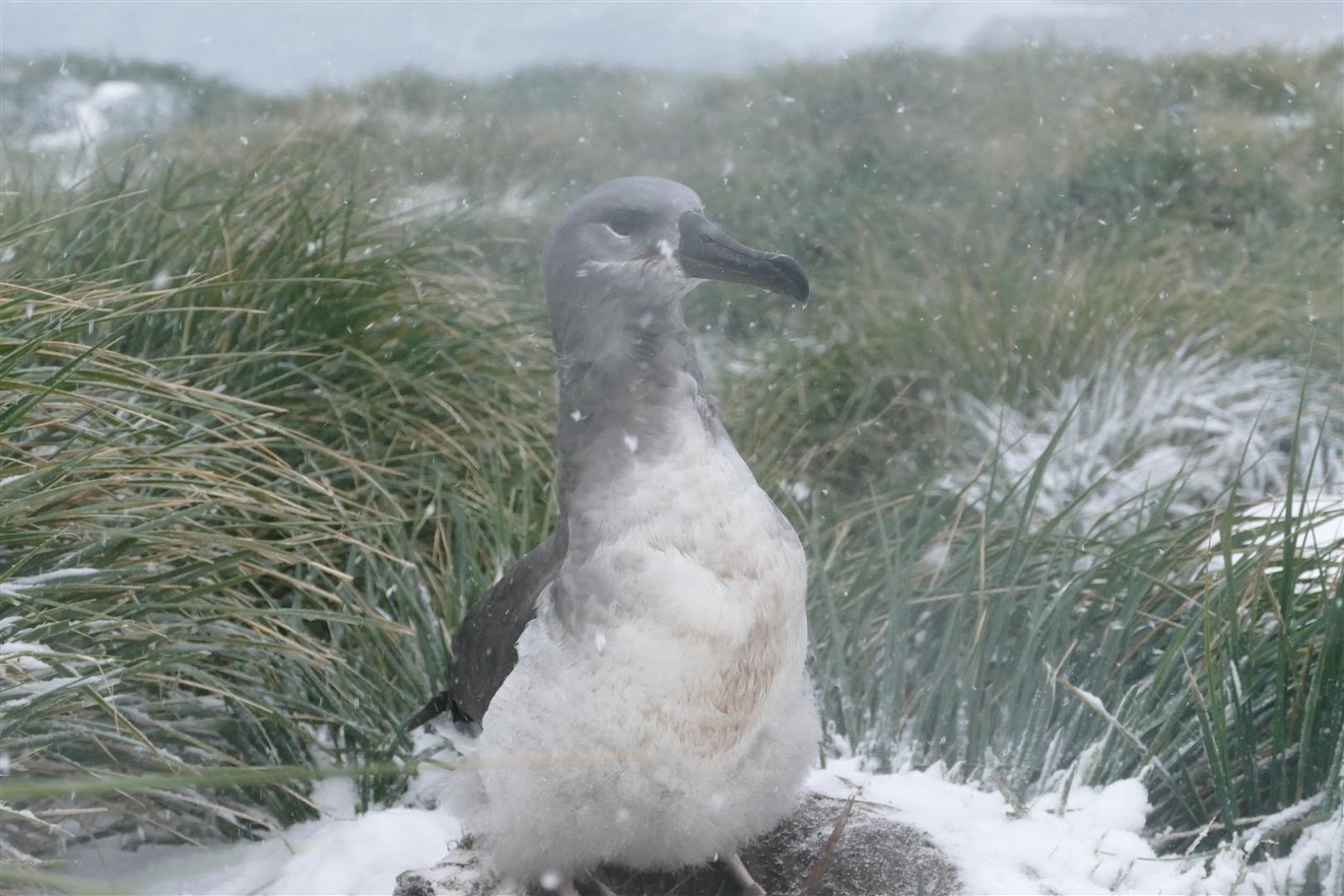
A grey-head chick in the snow
A grey-head chick just after a snow flurry looking very unimpressed!
Colony B also serves a great reminder of my usual role as Penguin and Petrel ZFA. There is a great view over to the macaroni colony at Big Mac (although its current emptiness makes it quite lonely and very quiet until October!) and there are also Antarctic prions nesting under the hut (although they have now fledged as well!).
An empty and snow covered Big Mac
A prion chick, back when it was fluffy!
One extra piece of work at this time of year is to go to some other mollie colonies and count the number of chicks present just before fledging begins. By doing this at the end of the season we can get an estimate of productivity for more colonies than just our regular study ones.
Jerry taking a moment for some photos during the grey-head census... mid snow storm
Of course, as we are checking many colonies, some of them very regularly, at this time of year we are witnessing some of the chicks preparing for the world ahead of them.
Time to stretch those wings!
But it is not just the two species I have in the albatross work. There is the continuing survey of the light-mantled sooty albatross. Unfortunately, like many of our species, the sooties have had a bad year and in our study area there is just one chick left! But it is braving the winter weather and will hopefully make it to fledging.
A sooty chick pre-snow blizzards, he was too sensible and stayed hunkered down (out of camera range) in the snow!
Of course, I can’t look after the albatross' for Lucy without spending plenty of time with the wanals. These are our only resident bird to be raising chicks through the winter. The nests are built up from the ground in order to keep the chicks raised above the snow and ice layer through the season and the chicks will get progressively bigger. So there will be plenty of updates on their progress through the year!
Footprints in the snow
The whole family chilling out
The chicks are on their own most of the time now, but they seem to enjoy themselves
The new definition of cute!