Showing posts with label Pintail. Show all posts

Sunday, 29 January 2017

White-chins and chicks

November and December are always exciting times on Bird Island as many of our study species being to hatch. In mid-November the northern geeps began hatching, followed shortly by the gentoos.
A northern geep chick just pipping out of its egg!
Geep chick being brooded
Gentoo chicks
By the end of the month we were seeing ducklings running around, although pintail breeding times can be so variable we were also lucky enough to find a nest of eggs in December – a very rare sighting!
A pintail nest, only the second I have seen and the hardest nest to find on BI!
Then in December the skuas were hatching closely followed by the macs and mollies in the middle of the month. The final species to hatch at this time were the southern geeps at the end of the month.
Skua chick
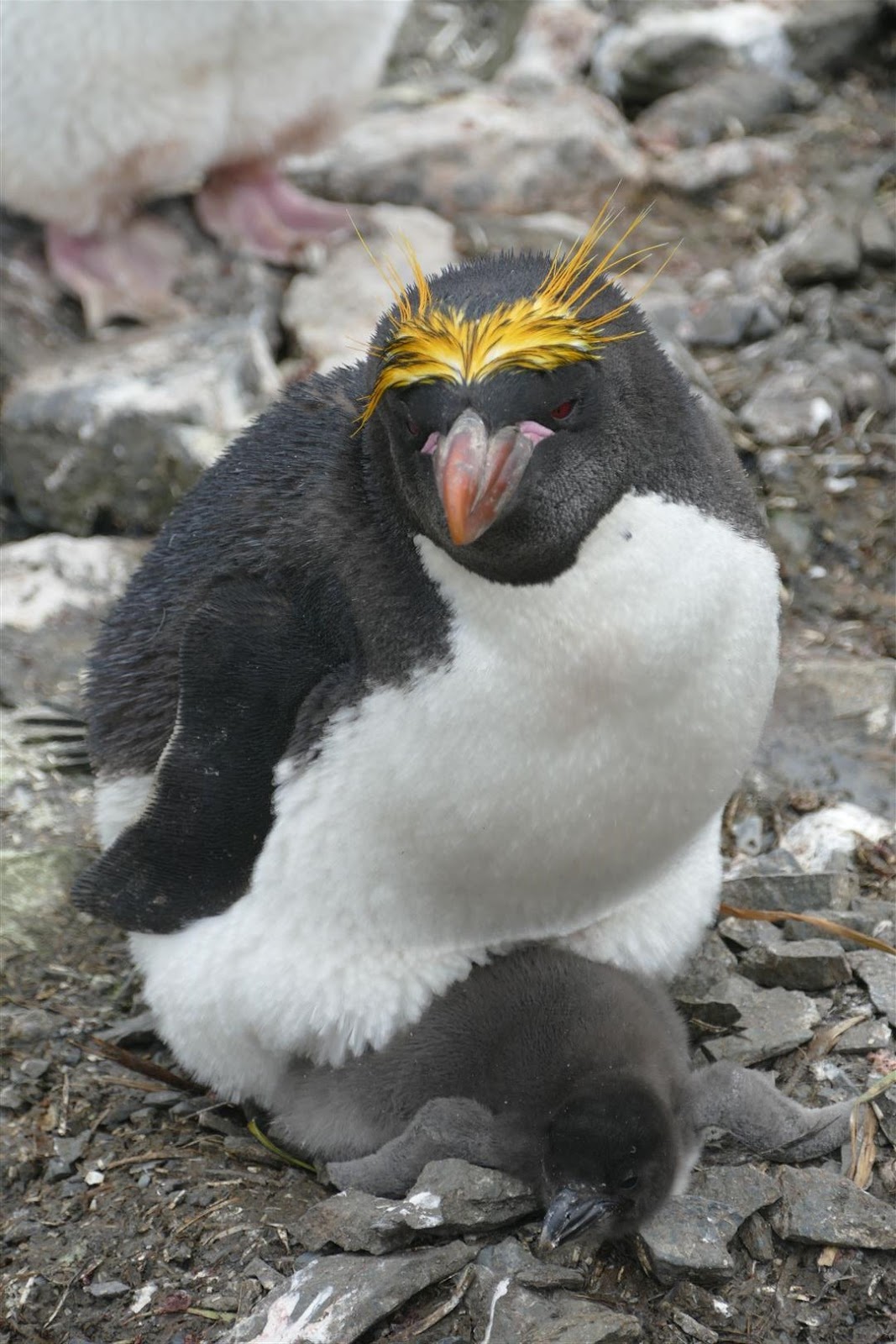
Mac chick
It is great to see all the life around the island and whilst some species are faring better than others at this stage at least there are no breeding crashes like there was for the gentoos last season! Of course it is not just the birds that are progressing, the seal pups are growing up well and enjoying being left alone around the beaches by their mums who are going out to feed.

A puppy trying to investigate inside a log!
"Who are you? Intruding on our puppy party!"
They are very curious at this stage, and tough little guys!
Not all species are at the young stage though, the wanderers take so long to raise a chick that they don’t actually lay their eggs until mid-December and won’t hatch until March. Alongside this whilst most chicks have fledged there are still a few stranglers left by the end of the month and these won’t take their first flight until January, by which time all of this years’ eggs will have been laid! (This is why wanals only breed once every 2 years, they don’t have the time/energy to lay an egg and raise a chick so close after their previous chick has fledged.)

A wanal not yet quite ready to fledge
'Superhero wanal' - so called because of the mask look on the face - practicing to fly
But amongst all this excitement and regular studying of all these species this December marked a very special survey for us. Last year we had the all island giant petrel census, but this year we had the all island white-chinned petrel census!

White-chins are burrow nesting seabirds and are about the size of a magpie but shaped like an albatross! This breeding habit makes them more difficult to survey than giant petrels who could simply be counted every time one was seen. In fact counting a few thousand giant petrels above ground is much simpler than counting a few magnitudes more of underground white-chins! So a different method is required.
White-chins are hard to get photos of, so having to re-use a couple from a blog last year...
Instead of trying to count all burrows, a near impossible task that would take months, we instead set up quadrats in areas that represent the surrounding habitat and terrain and counted the number of burrows within the quadrat alone; therefore we don't actually have to count all burrows on the island, so long as we are representative of the island as a whole the numbers can be extrapolated. Each burrow is checked for occupancy in order to determine the ratio of active to inactive burrows.
...but when the photos are this good I can't help it!
Whilst using this quadrat method makes the survey feasible it is still a long-haul survey. We conducted 495 individual quadrats, representing the habitats across the entire island, across 12 days of work (15th-24th, 27th and 31st December). Usually a quadrat would take 4 people to survey, two taking measurements of the habitat (tussock height, seal presence, incline, orientation, tussock cover) with the other two counting and assessing burrows. Repeating this process 495 times takes a lot of effort but it was a lot of fun – except when sticking our heads in the tussock during hayfever season makes us suffer through some of it!
Measuring the habitat (Photo courtesy of Carrie)
This census was one of the biggest I have ever conducted and it went incredibly well, white-chins are potentially becoming my favourite species, their call is something I will always remember, particularly as it is the sound I go to sleep with – they are nesting in the tussock behind base as well – and they have a very striking look despite being almost all black. They can be quite curious birds and I am very happy to have worked so much with a species that is not usually studied this way (all island census’ for any species only occur every 5 or 10 years depending on the species, except wanals which are an annual survey).
A white-chin lands mid-survey...
...and just hangs around to see what we are doing! :)

Thursday, 1 September 2016

Springtime?!?

August is a transition time for the bird work on BI. During August the last surveys are done for the 2015/16 season and final preparations are made for the first surveys of the 2016/17, which start on the 1st September.
Pipits survive the winter foraging along the water line; as our only songbird when they start calling it is a wonderful sign of spring!
With the final pintail counts completed in August and final all-island checks of the wanal chicks completed by, or on, the 1st September it certainly feels like the end of a season. Working with the wanals is a particular highlight at this time of year as the chicks start to develop their feathers and become a bit more adventurous, leaving the nest and starting to wander around!
The fluffy chicks are getting bigger
But unfortunately, despite now being on the lookout for signs of it, spring certainly isn't here just yet! The snow and ice are still in control of the island and trudging through it all on our surveys can be a challenge at times - especially when we still manage to find holes, some of which are head height!
Lucy enjoyed watching me try and climb out of a 6ft hole!
Of course, if we ever needed confirmation that winter is still very much holding on to BI all we need to do is look out the window! Leopard seals have been around in good numbers recently, on occasion we have had up to 6 leps hauled out within view of our front door!
The leprasaurus' always look so happy with themselves!
It's a hard life for a lep!
It is not just the leps either. There are some birds that are clinging on to the winter conditions as well with terns in good numbers feeding in the bays and even the occasional snow petrel (also referred to as snope) feeding on the waters surface.
Terns and snopes looking for food
Despite seeing the snow, ice and winter wildlife we can say that spring is at least on its way though as we have had the first actual sign of the new season beginning - the northern giant petrels are pairing up and starting to mate!
Northern geeps are getting ready for the new season
It won't be long now until the mollymawks start returning, the gentoos start nesting and come October we will see sooties and the return of the macs! It really is beginning to feel like the season is changing - if only the snow and ice would recognise that as well!!
The sun occasionally tries to bring on spring, I'm sure it'll get there eventually!

Monday, 6 June 2016

A Week in Winter

Now that the molly chicks have fledged and sweeps for dead chicks completed for each colony the amount of wildlife I have to monitor has greatly reduced. In fact most of the geeps have fledged as well with just one final southern chick yet to go.
Dead chick sweeps allow us to find any chicks that didn't make it so that we get an accurate count of productivity. Driving wind and ice on the ground makes it difficult and quite laborious though! (Photo courtesy of Jerry).
The last chick of my field season!!
But despite the lack of mollies and geeps to keep me entertained there are still plenty of things to be getting on with for work. Most of it is office or lab based work but there are some species still around that need surveying through winter. So here is what happens in a typical week for winter on BI.

Monday

On Monday I completed the geep work for the year by typing the final results into our databases. Whilst there is still one chick left I could upload all the data and just adjust for the final chick when it does fledge. Our online databases link directly back to BAS Cambridge where our managers can review the years’ data.
A database, a graph and a spreadsheet open at once - yep, I am a scientist! :)
Of course it is difficult to stay inside all day, even when we are firmly in the grip of winter, as there is so much wildlife still around. So I spent a short time in the afternoon just out in front of base with some kelp gulls and Antarctic terns feeding amongst the kelp.
Kelp gulls, adults and fledglings
Getting photos of these quick flyers is not easy! Especially when they are fishing in a snow flurry.
Tuesday

In just a few weeks time we will be celebrating midwinter down south. This is a big celebration each year, partly because we are generally too busy around Christmas to get the full holiday spirit going (although Christmas was a lot of fun!) and partly because there are a few events that bring all bases on the continent together at this time – more on all that in blogs around midwinter. But what we do also have is a Secret Santa type arrangement where we all make a gift for someone else on base to open at midwinter. This is a great reason to fully utilise our workshop and get busy with some woodcraft!
Jerry and I working away on our projects (photo courtesy of Ian).
After putting some final touches to my midwinter gift it was time to get in to the lab and begin some identification work. The krill, squid beaks and otoliths (fish ear bones) collected from macaroni penguin and geep diet samples through the summer now have to be measured to identify sex, life stage (krill only) and species (squid and fish). By doing a few hours a day a few days a week the lab work is completed in plenty of time for the final season reports (in August) without us getting stuck in there for too long at any one time – staring through a microscope at tiny bones gets a bit draining!
Jerry very kindly came in to help me get started on the lab work; measuring krill this time.
Wednesday

The wandering albatross raise their chicks all through winter and as such we are never fully deserted of wildlife to monitor. The first of each month, until September, marks an all island wanal census where we go out and check that each nest is still active, recording those that have failed in the preceding month. The chicks are now getting noticeably bigger and filling up their nests very nicely!
Wanals chicks are amazing (even the grumpy one in the bottom right!).
I covered an area on the east side of BI with the furthest wanal chick being all the way on the point of Farewell Point, the eastern extreme of the island. This is an area we get to rarely as there is little survey work on this part of the island, so it is always amazing to be able to get out and see a different location occasionally.

During the census Ian actually confirmed the final geep chick to have now fledged! Goodbye geepsy chicks, good luck! Now it is a case of waiting until September for the breeding season to start anew.

Thursday

Now that there are just 4 people on base the cooking rotation comes around quicker than before. Thursday was my shift this week and whilst we are obviously lacking in the fresh food department we are certainly not restricted when it comes to frozen or dried foods.
We have excellent supplies of frozen and tinned veg and fruit, dried pulses and herbs, juice, baking supplies (we make our own bread as well), cereals, sauces, milk (powdered), tea and coffee and much more  - but more importantly there is plenty of chocolate, cheese and bacon :)
The cooking rota can sometimes be a bit of a pain, but that is when simple meals like baked potatoes and pasta pesto come in handy. Other times it is a great opportunity to experiment and try something different as during winter we generally have a bit more time to prepare. The quality of food served on BI has been very high and much more varied than I expected to be possible before coming south.

During summer every meal was eaten at the table. But during winter we have weekend meals at the table but during the week we switch to TV dinners, often followed up by a bit of Mario Kart or Super Mario Bros. on the Wii.

Friday

Friday is our scrubout day. The base is divided into sections; boot room and toilets, kitchen and foodstores, living room and offices, lab and waste management. We rotate through these jobs each taking a different area each Friday and giving it a good clean. The base well kept and these regular scrubbings make sure it stays that way.
A photo of a mop would be boring (although I did clean, honest!), instead here is a skua :)
Besides all the work done during the week and the ways we relax in the evening there are times during winter when it is quiet enough to have a bit of a slow afternoon. When this happens it can be filled with any amount of hobbies. There are puzzles and craft books on base, a whole bookcase full of novels to read, the workshop is always available for projects to be done and of course there is whatever we brought down ourselves to keep us entertained. So I spent Friday afternoon reading James Herriot and colouring in some Zygons! Not a bad way to relax!
Doctor Who is amazing and colouring isn't just for primary school :) keeping in the lines is still difficult though!
Saturday

Saturday is a day we always make sure to put a bit extra effort in to doing something as a group. This is particularly helpful during the summer when we are all so busy with fieldwork that we may not spend that much time with other people. But the tradition continues through winter with Saturday being a three-course meal and can be a themed night (although not always).
Clockwise from top left: wig night from back in the summer, Nintendo night, League of Distinguished Gentlemen and Star Wars (Photos courtesy of Al, Jerry and Ian).
We usually follow up the meal with a game of some sort, sometimes this is cards or a board game, other times it can be a pub quiz, dance night or some other game we have designed and built for the station. From cornhole to murder mystery, lightsaber battles to monopoly, stargazing to rummy we have done quite a few different things over the previous weeks and months; and this week James was on Saturday cook and set up a great meal and some fun card games.

Sunday

Once a fortnight there is another survey to keep me outside with the wildlife, the pintail and sheathbill count. This is conducted along a stretch of coastline either side of base and usually takes about two hours, walking along the coast and counting every sheathbill and pintail along the way.
Ian counting some ducks
This gives us an indication of wintering populations for comparison to work ongoing at King Edward Point and the work they are doing there after the rat eradication project (Bird Island was already rat free and so can be a control location).

When it has been snowing quite a lot then the tussock gets hidden under a blanket of white. This makes it a lot of fun walking around between places, crunching in the snow or sliding down slopes. Of course we are always in danger of not seeing a gap below the snow and falling through the tussock!
We get used to falling knee or even waist deep in snow, but shoulder deep was an interesting one!
The pintail route along the coast is the same as the leopard seal route, so whilst counting ducks and sheathbills we also keep an eye out for leps. These guys are absolutely massive, the largest getting up to 3.5 metres (males) to 4 metres (females) long! It is great seeing such a well developed predator up close.
The sheathbill says: "Oi! Count me not the lep!"
After work it is always nice to relax and every Wednesday and Sunday are film nights. We are lucky enough to have a projector hooked up to our TV on station and so have our own mini-cinema for these occasions. Whoever is on cook gets the film choice that day so everyone gets a fair share of picking the film, this week it was Ian’s choice and we watched The World's Fastest Indian which is a great film!
Not a bad way to finish the week :)

Tuesday, 26 April 2016

Winter is...... here!

It has been about two months since I have updated this blog so it is time to catch up!

The reason for the big delay between posts has been how busy the work has been in this time. In early April we had Last Call when the RRS Ernest Shackleton dropped off our last bits of cargo and food for the 7 month winter ahead whilst also taking Al and Siân back home, it was amazing to work with you both and you are greatly missed on the island! Of course, not only did we have to prepare for the Shack but I also had to prepare for taking on the albatross ZFA role as well. As previously mentioned Lucy is staying on here for a second winter which means going on a well-earned holiday for a time first, so Lucy has trained me in her role to cover the workload for April and May.... but there will be more on that in the next blog!

So what has happened in the past two months? Well the main change has been winter has come (but thankfully no white-walkers are yet to terrorize our shores)!
No white-walkers but plenty of gentoos around in the snow
The changing seasons has made a big difference to the species we see around as the northern geeps have now all fledged and the macaroni penguins have all left the island until they come back in October. The southern giant petrels are about to fledge as well whilst the mollies will also be gone by the end of May.
With no macaronis left it was time to dismantle the weighbridge for the winter (Photo courtesy of Jerry)
But that doesn’t mean we are deserted for the winter, far from it! In this season numbers of other birds greatly increases. Pipits and pintails are pushed out of the islands interior, where ponds freeze and tussock gets covered in snow, down into the bays where they can forage in the shallows or strand line.
Pipits are more common on the rocky shorelines now
Pintails are actually one of two species, alongside sheathbills, that I will be counting twice a month from May to August. But when you get over 200 of them in one go it is worth counting them a few weeks early!
211 pintails in one location!
Gulls and shags can still be seen around the coast in good numbers as well but the greatest difference is in the smaller petrels. Cape petrels have made their way in to our bays in large numbers to feed on small critters in the seaweed and we are occasionally treated to a glimpse of storm-petrels as well!
Cape petrels rivaling the pintails for numbers, 170 is the biggest count in one location so far!
Flying past a cape petrel, I got quick glimpses of a stormie!
Not only has the bird world changed but so has the mammal world. Winter marks the arrival of leopard seals. Whilst we had an unseasonal visitor back in February it is May to October when these massive creatures normally come ashore. That being said, they have arrived early and we have already had over 15 sightings in April alone!
A leopard seal, called 'Jumpy Jim', enjoying a snooze
Cute but a fearsome predator
James using sticks lined up with head and tail to measure 'Max'
But whilst all the wildlife has been great to watch in transition when talking about the arrival of winter on a sub-Antarctic island there is only one element of change that gets the prize for most dramatic – snow/ice!
Went for a quick session photographing a lep next to base and get hit by the snow! (Photo courtesy of James)
Not long after Last Call in early April we got the first flurries of snow. This was followed by a day when the wind gusts topped 50 knots and the base was literally shaking around us (it’s built to withstand that though, so it’s normal in bad weather!). Waking up after a night when the 50 knot winds were dying down was an interesting sight for us all..... ice! And lots of it!
Ice filling the bay and altering the coastline
Not only had ice been blown in to the bay outside base but it had arrived in such large quantities that it covered the shoreline quite spectacularly and pretty much drowned our jetty from view. There was so much in fact that much of it is still here two weeks later.
Jerry looking out over the ice
After all the ice came in we had regular snow falls which has now left the island covered in snow ranging from 2 inches thick to waist deep depending on the topography of where we are. This had made traversing the island to complete our ongoing fieldwork more of a challenge, chains on our boots help combat the slippery ice, but when walking across tussock or part-frozen bogs it is near impossible to see where the big gaps or weak spots are. This has resulted in numerous falls for us all and occasional wet feet as we go through the ice layer up to our knees, or even our waists on occasion!

But despite the difficulties it poses having the whole island covered in snow is absolutely breathtaking and at least makes going downhill much more fun and a lot quicker!
Wanal chicks are happy on their nests despite the snow all around