Tuesday, 16 February 2016

Penguin Time!

So I have written about all sorts so far – geeps, skuas, wanals and mollies, brief interludes with seals and white-chins, and even why we are all blonde! But given my job title there has been something distinctly lacking and it is time to put that right.... so here come the penguins!

First up we unfortunately have to get through some bad news. This year has been a disastrous year for our gentoo colonies with no breeding attempts being successful! The cause of this is being investigated but luckily I did get to see some hatch before they failed; however, this actually made the feeling of their bad time worse.
Gentoos on nest; a hatching; gentoo chick
But this is not a first time thing for the gentoos. Poor breeding years have happened in the past but the adult population survives to try again in better conditions the next year. So fingers crossed I bring you news of a good gentoo season next summer! However, not all penguin news is bad news; the macs are doing just fine!
Macaroni penguins
We have a number of different workstreams around the penguin colonies, all designed to better understand the population. Our work focuses in two colonies on the west side of BI; Little Mac and Big Mac.
Little Mac and Fairy Point Hut with a view of Big Mac in the background
Big Mac is absolutely awe-inspiring! To be amongst 80,000 penguins is an incredible experience, even if the weather on BI is so changeable that one minute we are counting in clear, but still cold, weather and the next a snow flurry is obscuring our view!
Changeable weather for counting macs - 10 minutes separates these photos!
Obviously counting so many penguins regularly would be impossible. As such we have transects through the colony that remain constant every year – marked by yellow stones – that are counted so that we can study any changes in the population. The transects are counted once during incubation and again when the chicks are hatching.
Incubating an egg and caring for a chick
Little Mac however is small enough that the entire colony is counted on the same days as the Big Mac transects. Whilst it is smaller it is actually much harder to count! Just a mass of penguins with no discernible boundaries within the colony makes accurately counting every penguin on a nest quite difficult.
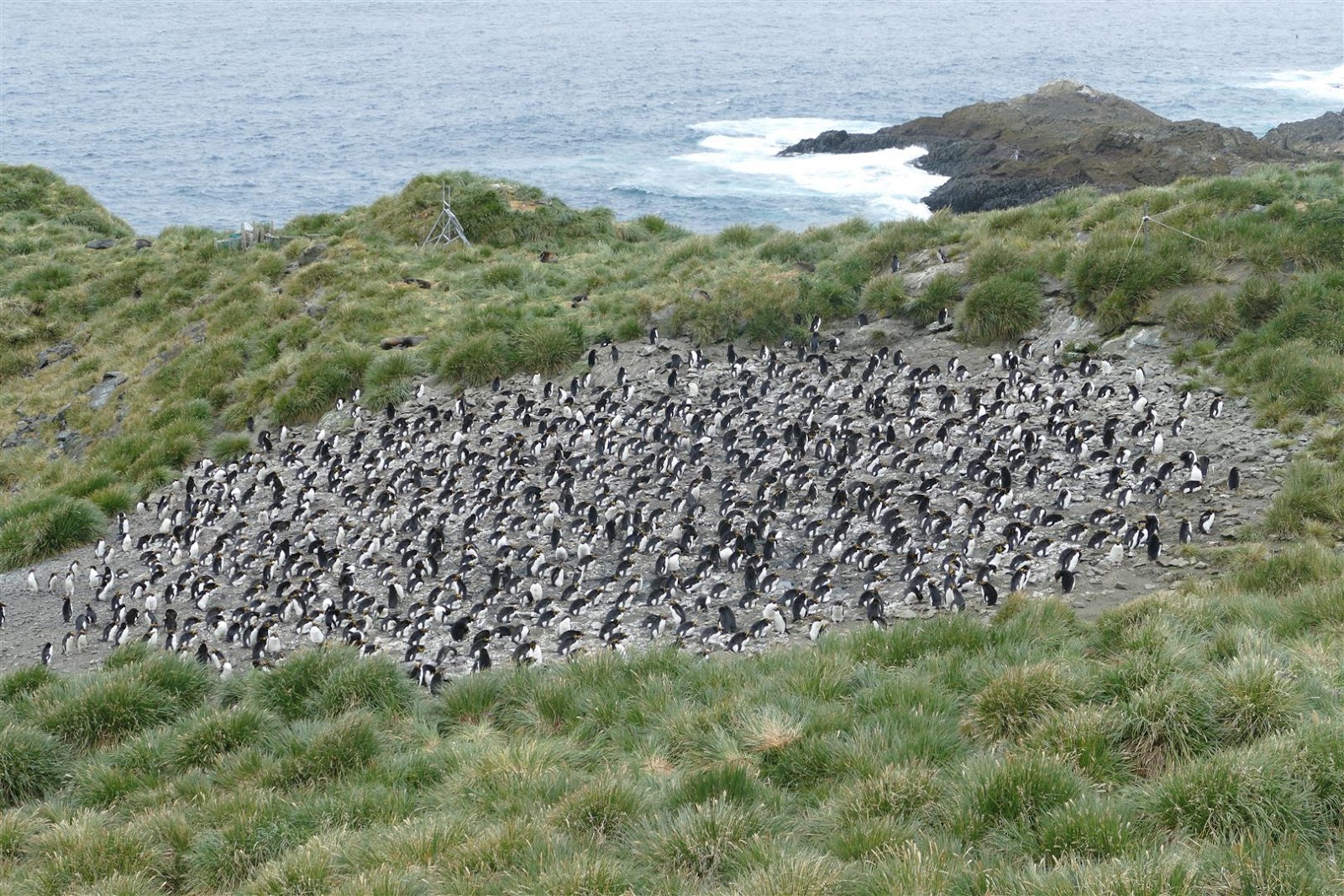
Anyone fancy counting? Remember to only count those on a nest! :)
Even though counting them can be challenging at times it is impossible not to enjoy the work because being in the colonies of such funky little birds is absolutely magnificent!
Can't get enough of these cool little penguins
Their feathers are so thick and waterproof that the snow just sticks to the edge of them
Directing the traffic through the colony!
By mid-January the chicks are already growing rapidly. They are being left on their own at times and are even starting to form small crèches to keep warm. 
The chicks are growing well
Then by mid-February the chicks are really big, whilst at the same time immature birds are arriving at the colony to moult.
A moulting mac gives a chick a little hug on its way through the colony
The views that the chicks get across Big Mac are very impressive when the sun is out and it is always amazing to see them developing and beginning to grow their own feathers.
The views the chicks get when growing up are absolutely stunning!
Whilst the views at Big Mac are impressive it is at Little Mac where our work with the chicks takes place as we count how many have survived to fledging age in mid-February.
Counting all the chicks moving around the colony is a challenge
The chicks begin to look quite funny whilst moulting, not long until this dude is ready to fledge!
Soon the chicks will fully fledge and when they do the adults will go as well to feed. The adults will return after a month to moult and then leave a month later again to spend the winter away feeding, getting ready for their return for the next breeding season to begin in October.

Whilst the gentoos have had a bad year and the macs are doing well I should also mention a third penguin species. Whilst they don’t breed on BI we do get decent numbers of king penguins passing through from South Georgia. Some of these penguins are here just to rest whilst others are moulting, but either way it is always great to see some royalty around!
King penguins, looking either regal or scruffy depending on moult
Finally, there is also a fourth species to drop by Bird Island. Again only on passing through do we see this species and it is a much rarer sighting than the kings, coming ashore on occasion and normally just a single individual. But we do get a few chances each year to see a chinstrap penguin up close, a great opportunity as we haven't seen them since travelling down south on the JCR.

Chinstrap penguin visiting Bird Island and saying hello to its close relation, the gentoo
With only 17 species of penguins across the southern hemisphere (and therefore in the whole world) it is spectacular to be living in a location where I can see 4 of them in one day!
What a handsome penguin!

Friday, 5 February 2016

Wandering Albatross Breeding Season

Since early December the wanals have been returning to BI to get ready for the new breeding season. These birds are not annual breeders though, if successful in raising a chick they only breed on alternate years. This is because the egg is laid in December, hatches in March but then takes around 278 days to fledge!
A couple of small patches of fluff still but this chick is ready to fledge!
This means the chicks do not leave until November to January time and so the adults do not have the resources to breed again immediately. They must spend a year out to sea feeding, but for birds that are long-lived (some pass 50 years old!) and only reach breeding maturity at around 10 years old they can take their time.
Male on the nest (much whiter), female standing guard (greyer edges to feathers, darker wings and smaller head)
The adults that did not breed last year are now back on BI though and they have been displaying and conducting their courtship rituals, giving us great views of sky-pointing and wing stretching displays.
Sky-pointing and wing display
Lucy monitors the study colony of wanals regularly, but as the new nesting season has begun it was time to go out and stake every nest on the island. As you will have seen when we completed the geep census, covering the whole island isn’t the easiest task but at least the wanals are large enough to be spotted from much greater distances!
Wanals can be seen across the landscape

Staking takes place over 2 periods of a week each in order to get all nests that arrive at slightly different times. The first week was over Christmas and New Year! The second week took place from the 5th January.
Wanal counting on Christmas Day!
Nests are only staked if the adults are confirmed to be breeding pairs. This means checking that each nest has an egg.
Wanal egg being incubated by dad and protected by mum from a neighbouring adult behind!
After a lot of effort from everyone on the team the first staking round was successfully completed on the 31st December and the second on the 10th January. From this point on it was our task to try and confirm the identity of both partners on every nest. Therefore, whenever we were out in the field we would check the wanal nests in that area to try and confirm the partners.
It is always helpful when both adults are in attendance together
By doing this regularly we were able to confirm both attending adults for a lot of the nests but in order to try and get as many as possible as soon as possible we completed a full island survey on the 31st January and 1st February. By covering the whole island in just 2 days we were able to confirm a lot more partners, and now it is back to checking the remaining nests over the coming weeks to complete all the partners.
Majestic birds!

Wednesday, 3 February 2016

Big Garden Birdwatch

The Big Garden Birdwatch is a survey the RSPB carries out every year, encouraging citizen science to better understand the patterns in birdlife we find in our gardens. It is a very valuable survey that has helped indicate declines in birds such as greenfinches, starlings and house sparrows which have then been subject to further study. But the best thing about the survey is it is an excuse to just sit and admire the wildlife in your garden (not that an excuse should ever be needed to do that!).
The view I had for the count
Counting the birds through my living room window
Now that I am living in the sub-Antarctic for 18 months I was initially missing the possibility of counting all those goldfinches and blue tits in my garden back home. But then my friend, Mel Broadhurst, whom I worked with in Alderney, got in touch to ask me to do the Big Garden Birdwatch here on Bird Island – I certainly didn’t need asking twice!
King penguins are moulting in our garden at this time of year
So on the 30th January I spent an hour watching the birds in our ‘front garden’, noting the number of each species in attendance. The results are taken from when the peak number of any species is recorded during the hour, therefore in my front garden I counted:
·         14 snowy sheathbill
·         39 brown skua
·         14 northern giant petrel
·         28 king penguin
·         1 gentoo penguin
·         1 kelp gull
·         2 antarctic tern
·         2 South Georgia pipit
·         1 South Georgia pintail
A snowy sheathbill feeding around the fur seals
Brown skuas are our most frequent garden bird, feeding on seal carrion
A northern giant petrel relaxing in the garden with a skua feeding behind
Doing a survey like this makes me realize again how surreal and amazing it is to be able to say there are penguins in my front garden! Filling out the results for submission to the RSPB was also interesting; describing the ‘garden’ as more than 5km away from farmland is an unusual moniker for BI and unfortunately there were no options for fur seal carrion in the feeding section. But still, it was brilliant to do the survey in such an unusual location and really brought a slice of the UK to my wildlife adventure in the sub-Antarctic.
Some king penguins walking through the garden past the resident skuas
Meanwhile in Alderney there were 1 dunnock, 1 blue tit and 3 blackbirds recorded in a local garden whilst the team taking part also made bird boxes. The high winds kept numbers low but all results from these surveys are very valuable and I do miss seeing our local UK birds! Well done to everyone that took part with the Alderney Wildlife Trust, let's do it again next year! :)

Sunday, 17 January 2016

Mollymawks

There are three Zoological Field Assistant roles on BI: the giant petrel and penguin, the seal and the albatross. The three positions last around 18 months. This allows us to learn the job from the current ZFA’s when we first arrive in November until they leave in April; then we complete the winter ourselves before handing over to the next group the following November to April.
Al going through the GPS settings with me before a study (Photo courtesy of Lucy)
This works really well as it means each position has 2 ZFA’s working in it during each summer when work loads are higher. However, as Lucy, the albatross ZFA, has extended to stay for an extra year there was no second albatross ZFA for the current summer. This means that whenever I can, around the giant petrel and penguin work, I become an albatross assistant as well and get to work with the mollymawks.
Lucy monitoring in a grey-head colony
Mollymawks, the common term for any albatross species in the genus Thalassarche – which on BI consists of the grey-heads and black-brows – nest in colonies all across the island. These colonies are designated by the alphabet and it is in colonies B, E, H, J and N where most of our molly work is completed.
Molly colonies (black-brow colony N on the left, grey-head colony B on the right) are on steep tussock slopes
The colonies are often one species or the other although they can have some mixing going on. However, these two species do not interbreed as it takes grey-heads longer to raise a chick (69-78 days incubation, 140 days chick rearing) than the black-brows (65-72 days incubation, 110-125 days chick rearing) and as such they nest biennially as opposed to annually.
Grey-head colony with a few black-brows on the edge mixing in
Much like with the giant petrels and skuas our work consists of monitoring these areas for population and productivity; going through each colony systematically counting the nests that are still active.
Lucy checking a black-brow colony
Now we have passed the hatching period and the chicks are being raised by the adults. It is amazing to see these little albatrosses growing bigger and hopefully they have a successful season!
The chicks are starting to get big enough to be left on their own (grey-head the two left, black-brow two right)
By doing the surveying of these colonies alongside Lucy as much as I can I am able to learn the layout of each of the five colonies. This will be very important as the chicks will be nearly fully grown and then beginning to fledge in April and May; the time when Lucy will be away to have a short break between her extended stay on BI, so it will be my responsibility to ensure the monitoring is continued in Lucy’s absence.
Black-brow wondering why I am looking happy when collecting its poo! (Photo courtesy of Lucy)
It is not just the mollies that are surveyed either. The sooties are also checked for population and productivity but on a less frequent basis as they are a more nervous species. Due to the location of their nests, the sooties are often on cliff ledges, monitoring is done from a distance by binoculars.
Unfortunately the sooty nests are just too far away for decent pictures, so here is an adult I got closer to
It is a privilege to be able to be so involved with these species; alongside my regular work with the petrels and penguins I couldn’t have wished for a more varied and thorough experience of seabird monitoring in the Antarctic!

Sunday, 3 January 2016

White-chinned Petrels

I have previously briefly mentioned white-chins as being one of our study species and came across them for the first time during the geep census. White-chins are a petrel species in the order Procellariiformes - in other words 'tubenoses'. All petrels make up this order with fulmars and shearwaters, albatrosses, storm petrels and diving petrels. All are given this name due to the nostrils being located in a tube-like structure on top of the bill; smell plays a key role in foraging for these birds.

All Procellariiformes have very strong pair-bonds (not necessarily for life, although that can happen, but certainly long-term) and return to the same colonies to breed each year. They lay just one egg and whilst larger species like giant petrels and albatross nest above ground the smaller species nest in burrows for safety from predators. White-chins are one such species, digging their burrows with their beaks and claws - this is why seeing them above ground has been difficult.

But recently there have been a couple of locations on BI where the white-chins seem to really like sitting just outside their burrows, so we have unexpectedly been able to see them up close. Therefore, here are some much better photos of white-chins:
Calling to each other
Outside the burrow with the signs of digging on their beaks
Stunning looking birds with the small white patch on the chin in clear view
To think, this image isn't zoomed in at all! He must like the camera!
A clear view of the tubenose - petrels have excellent senses of smell
I certainly feel very lucky to be able to work with the more elusive species on BI as well as the larger albatrosses and geeps. Getting views of white-chins like this will always be a highlight for me!