Showing posts with label Sun. Show all posts

Thursday, 20 December 2018

Summertime!

The season is in full swing at Signy by the time we reach mid-summer and for the first time this season the sun has shown itself for nearly two full days!
With the sun shining on the huts at Gourlay the views are that much more spectacular
The Adelies were the first species to lay their eggs and as such they are at the most advanced breeding stage. The chicks are now pretty big and spill out from under the adults, although they are not yet quite big enough to be left unguarded.
One of many Adelie colonies on Signy
Spot all the fluffy chicks sticking out from under the adults!
The Adelies are great characters, the most boisterous and aggressive of the three penguin species here on Signy they can be heard calling almost continuously.
An Adelie calls and displays to its partner each time it returns to the nest
With the chicks getting that much bigger, and with the sun shining, the views we are getting of them are increasing rapidly. The peeping noises of the chicks can be heard almost as much as the calls of the adults and most of them can be seen standing up, stretching their flippers and begging for food!
Adelies lay two eggs and a number of nests are able to keep both chicks growing well
When the sun is out, the chicks are out so as to not get too hot, although some still prefer the comfort of the parents
Looking up at the sky, it's a bright new world for this chick!
Although the Adelies may be the most advanced they are by no means the only species very active at the moment. The Chinstraps are well in to incubation now and although there are a few stragglers just laying their eggs the majority will be starting to hatch in about a week's time.
Although most nests have eggs in them, that doesn't mean the nest can't be spruced up with a few new stones still!
The eggs are well incubated, even on sunny days as the air temperature and wind chill are still hovering around freezing!
It is not just the penguins that are active at this time of year. All our resident bird species are progressing with the breeding season. Our flying bird species - including: Snow Petrel, Wilson's Storm-Petrel. Antarctic Prion, Cape Petrel, Antarctic Tern, Brown Skua, Southern Giant Petrel and Snowy Sheathbill - are all now on nests with eggs to incubate. One of my favourites at the moment has to be the Snow Petrels, these strikingly beautiful birds can often be seen flying around, courting and displaying to each other.
Snow Petrel
Snow Petrels - along with Wilson's Storm-Petrels and Antarctic Prions - nest under rocks and in crevices so as to avoid the notice of predators. With Signy being such a rocky island there are so many places for them to breed that we are occasionally lucky enough to stumble across a nest site.
Often first found by the calls of the adults emanating from the rocks, Snow Petrels are now nesting for the season
All three species can be seen during the day, particularly the Snow Petrels, but they tend to be much more active at dusk and during the night when predators are less active and less likely to be able to see them coming ashore to the nest. However, there is one species that is active during the day that also nests under rock crevices; Snowy Sheathbills are more typically found near penguin colonies where there is a ready source of food available for this scavenging species.
Snowy Sheathbill
The predators that are being avoided by all these species are also busy making their own nests and incubating their own eggs. Brown Skuas are a regular sight across the island looking for anything they can predate so that they can be in full condition to raise their own chicks when the eggs hatch.
Brown Skua
Southern Giant Petrels can also predate and scavenge on the penguins and smaller petrels and prions. They are the largest flying species of bird on Signy and are still a particular favourite of mine from my time on Bird Island. Although the breeding colonies here on Signy are not visited as often as those on Bird Island we are still able to collect valuable data on the breeding success of this species each year.
A white morph Southern Giant Petrel - sometimes referred to as a 'spirit geep'
Although the birds are all busy during the summer breeding, the seals we have here are at a different stage of their life-cycle. Weddell, Elephant and Leopard Seals have all bred earlier in the year and pups have long-since been weined and gone their own ways. But that doesn't mean activity stops, in fact there are always seals about to see. Elephant Seals are a daily occurrence and they will continue to increase in numbers throughout the season. But Weddell and Leopard Seals are more infrequent sightings, particularly the Leps, and are most likely to be seen when there is ice in the bays.
Yep, this is a summer scene! Weddell Seals on ice in the bays around Signy
For the most part the seals are just ashore to sleep and relax whilst digesting their most recent meals.
A Weddell shows it's impressive teeth whilst having a yawn and a scratch!
Of the four species of seal we see on Signy (the fourth being Fur Seals - a fifth species, the Crabeater Seal, is a rarity but could also be seen if we are lucky!) the most infrequently seen is the Leopard Seal. Top predators these seals can grow up to 4 meters long and will eat penguins, skuas or anything they can get a hold of in the water or on the waters surface.
Leopard Seal
Leopard Seals are always an impressive sight, even if that is just whilst they are relaxing on the ice!
Two Leopard Seals on ice in the aptly named Hydrurga Cove (Hydrurga leptonyx is their scientific name)
With so many amazing species, and so much to see, an Antarctic summer is a very special time - even if the sun does only shine on the odd occasion!

Sunday, 23 April 2017

The Journey Home - Part 4: Ascension

It was nice to see KEP, Signy was spectacular and the Falklands incredible. But whilst they, and BI of course, come together to make such an amazing experience the sunny days were few and far between! So we needed some sun (34°C of it!! We melted!!) on the way home and the most direct flight home from the Falklands just happens to be via Ascension Island; so it would’ve been rude not to visit!
Taking a stroll through a cloud forest
Sandy beaches and sun would’ve been enough to relax in for a few days. But the Ascension is an amazing wildlife island all on its own and so Lucy, James and I were treated to a final few days of exciting sights together.
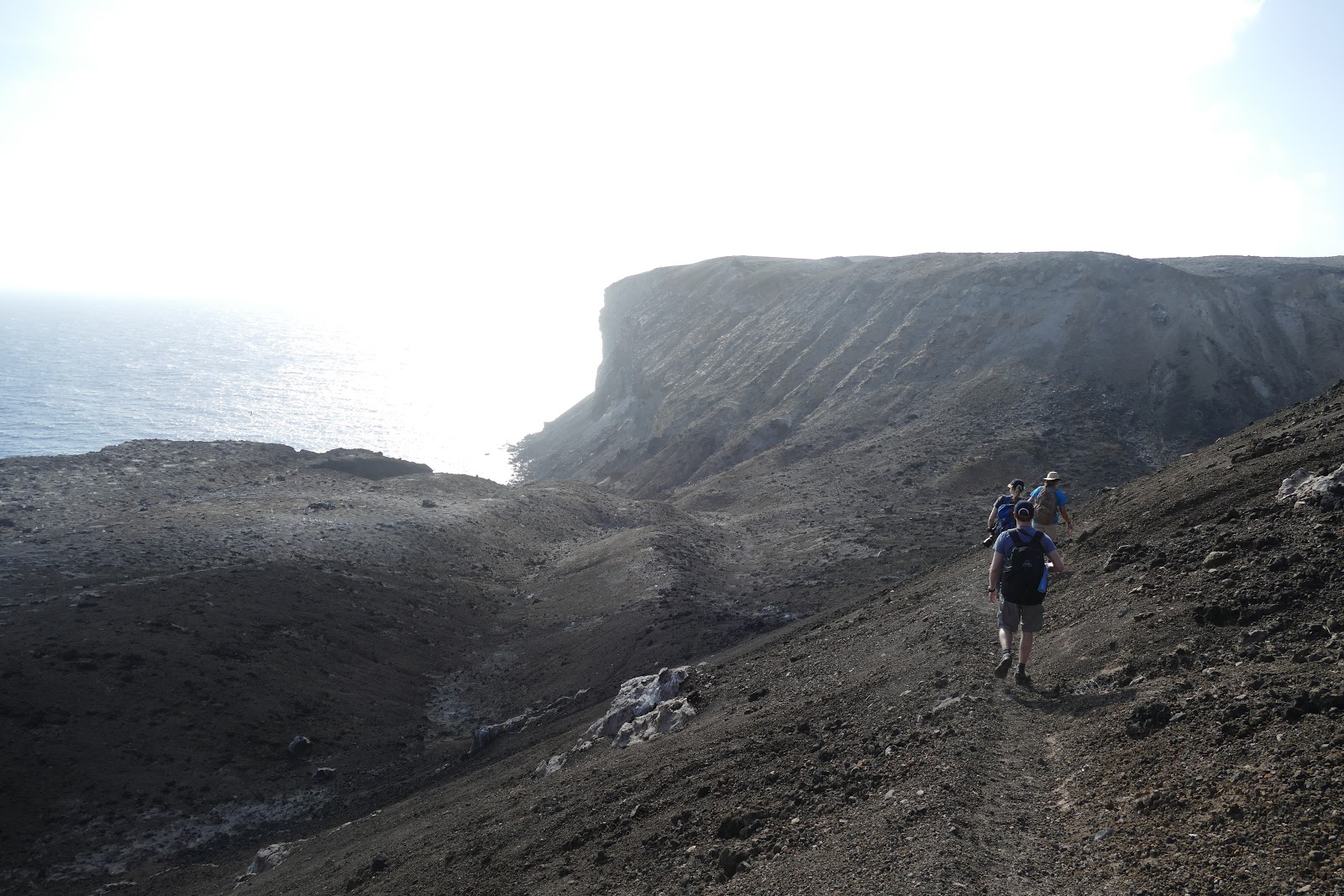
Two weeks we were walking across a glacier, now its a lava flow..... crazy!
Ascension is famous for its land crabs, and whilst it wasn’t the season for them in mass numbers we did see quite a few around in the early mornings coming out after a night of rain. They are real characters lifting their claws up at anything that goes by.
Land crabs are feisty little guys
Shore crabs make sure not all the attention is given to their land cousins
It is not just crabs to look out for though, Ascension is a very important breeding site for green turtles and spending some time in the late evening sitting on a beach watching them come ashore and dig their nests to lay eggs is something I will never forget. Alongside the adults laying eggs are the hatchlings escaping their eggs and sprinting down the shore to the ocean for the first time. Witnessing the turtles like this is something that will always amaze me!
A green turtle swims along (no photos of them nesting at night, but seeing them at any stage is still great)
A particular highlight for me though was the Galapagos sharks (yes, they have a range much larger than the name suggests)! I had never seen sharks, of any species, before so to stand on a pier and see a dozen sharks swimming around in the shallows was incredible!! Unfortunately though no photos were possible on this occasion, but you always have a reason for going back!
Well, they may not be the sharks, but sergeant major fish in the rockpools are still cool
Of course, seeing turtles, sharks and crabs was spectacular, but where there is an island with the right terrain there are seabirds……. and Ascension has some amazing species! In total we saw 8 different species and were lucky enough to be able to work with them as volunteers for the Ascensions Seabird Conservation Scientist, Eliza.
Switching the sub-antarctic for sweltering heat, anywhere there are seabirds needs investigating!
A masked booby colony, the first species we came across
The masked booby area stretches across the landscape
These birds are closely related to our gannets and you can tell just from the look of them
They have a very striking look to them
The masked booby nest develops into a circle of small stones surrounded by a circle of poo!
Due to the tropical nature of the island, whilst there is a main breeding season the birds can nest at any time. This means that all stages of the breeding cycle can be seen at the same time, from egg incubation...
...to small chicks...
...to fluffy little ones, starting to get as big as their parents...
...to ready to fledge!
After the masked booby we saw another species, the brown booby
The browns lay 2 eggs as opposed to the 1 of the masked
A brown booby flies overhead with an adult frigatebird in the background
After seeing the two species of booby the sky became full of another species...
....frigatebirds!
The majority of those flying around are chicks taking to the skies for the first time
It is amazing to see these birds flying around...
...and just above our heads no less!
A frigatebird chick about ready to fledge
Some of the chicks are still smaller and fluffy, but the adults are feeding them up well
They look funky when fluffy and grow up into very striking birds
Growing up in the heat can get quite tough in the middle of the day, but these birds do well
An adult female still broods a smaller chick
Adult males have a very noticeable red patch to the throat, this inflates to a large size during mating rituals
After the frigatebirds we moved on to see some a couple of species of noddy...
...brown noddy...
...and black noddy
Looking down towards the base of the cliffs showed us another species as well, the yellow-billed tropicbird!
Fairy terns also put in an appearance, darting around the rocks and being very curious coming to see who we are
Another day of seabird work, another new species to see, sooty terns!
There were tens of thousands of these little birds around, and quite a few were very curious as we walked along the paths around the colonies...
...peering down at us...
...flying past...
...and drifting around getting a good look...
...and making sure we knew they were around! As if the noise weren't enough :)
But ultimately, they are more interested in neighbours of their own species
Going to work in the colony shows that the sooty tern season is just starting...
...each bird looks after its single egg...
...just a reminder that I am leaving the end of the antarctic summer to join the summer in the northern hemisphere and begin working in a new seabird season. Isle of May, here I come!
Sadly, on the 8th April it was time for James and I to leave, Lucy staying on for a few more days. This meant that after 501 days of working together every day the three of us would be finishing our time as a research team! I couldn’t have asked for a better group and I will always be thankful to Lucy, James and all my BAS friends for such an amazing experience.


500 days together and still smiling :) a brilliant zoology team and amazing friends, thank you Luce and Jamins!
But after so much time away it is amazing to say that I am back home with family, friends and most importantly my very understanding girlfriend Nicci. Better yet, the next experience will be working for the Centre for Ecology and Hydrology on the Isle of May this summer with Nicci as we join their amazing seabird team researching puffins, shags, gulls, guillemots……….. and razorbills!!!!!!