Showing posts with label Glacier. Show all posts

Wednesday, 17 July 2019

A Stunning Country

I have been extremely fortunate to be asked to work in some amazing locations around the world. These are places I thought I’d never see, let alone get to work in for a prolonged period of time. So when I was invited to join BAS again I was thrilled, especially as this time they were sending me north – to Iceland!

I was stationed in Iceland for one month in the summer of 2019 to study two species of guillemots, more on this in a later blog, but the travelling required between study sites meant that I was able to see a lot of the country along the way; and what a country it is!
Driving around Iceland is near impossible without getting distracted by the scenery
Unfortunately no photo can do justice to the stunning scenery on offer (when I’m pointing the camera at least!) but nevertheless the views were stunning. On my first night we camped next to a glacial lagoon, just to get the feeling of polar work in early.

Arriving at the campsite on the first night in Iceland to this view - incredible!
Waking up to it isn't bad either!
The wildlife enjoys the area as well.
Iceland is a large country with a small population – just 300,000 residents compared with 3,000,000 tourists each year! – so towns and even farm houses are often spread quite far apart. Driving between them to get from one study site to another entailed lots of great views.

The views are hard to pass without taking a few photos.
Sometimes the route cuts through the landscape in very windy ways, making the view impressive and the driving interesting.
Besides the “standard” roadside hill and mountain views Iceland is rich in different landscapes. A land created by volcanoes and glaciers can’t be anything but spectacular and I was unable to draw myself away from the spectacle for a moment.

Ancient craters now grown over with vegetation.
Glacial valleys carved out so long ago are now home to woodlands and lakes.
Sandy beaches are always pleasant and black sand makes quite a change.
Whilst Iceland is very much still active in terms of planetary processes, more on that in the next blog, areas that have been active in the past but are now dormant provide some of the most interesting landscapes I have ever seen.

The lakes of Myvatn are in an area surrounded by craters.
The crater of Hverfjall towers over the Myvatn area and takes around 2 hours to walk around.
The ancient lava field of Dimmuborgum is now covered in vegetation with volcanic rock protruding out.
The fissure that is created by the slow pulling apart of the North American and European tectonic plates has created ridgelines of rock steeped in local history.
What Iceland also has in abundance is little hidden gems, areas that would be of great interest in most places but are often overlooked for the grander scenes.
The coastline at Langanes is ideal for seabirds but compared to others around Iceland isn't as well visited.
As an island Iceland is subject to tides dumping debris from the oceans quite a lot, but I was not expecting so much driftwood in a single bay!
Underground pools full of warm, or sometimes very hot, water can be found and used to be used for bathing by locals.
Picturesque streams and rivers are everywhere, linking waterfalls and lakes to the ocean.
Iceland would be worth a visit for the scenery alone, but that is just the beginning. The country is full of active Earth processes, plus an incredible amount of wildlife for a – geologically and biologically speaking – new island so that it is one of the most interesting places to see.

Monday, 3 December 2018

Views of Signy

Although I am working with the wildlife on Signy the island itself is something to appreciate as well. At about 7km at its longest by 5km at its widest the island is still a small one - although bigger than my previous home of Bird Island - but manages to fit in a whole range of landscape views that are quite incredible. The profile of Signy is highly variable with lots of moss banks, scree slopes, cliff faces and a glacier in the middle each time we visit a different area we get a completely different view of the island. Despite the fact that photos cannot truly show the scale and majesty of such a location I have got to try; so here are some examples of the landscape we are fortunate enough to work in:
The view from the base itself is a great way to start each day, looking over to Coronation Island
After climbing up the stonechute from base we reach the main path to the glacier, this path overlooks Shallow Bay (which is crossable on low-tide) and the almost ever present Coronation Island is very impressive across the sea
The McLeod Glacier quickly comes in to view, as does the snow that has heaped on top of it over the winter, snow that is now starting to fall away more each day
The main path from base to the glacier runs across the side of scree slopes that themselves offer something interesting to the landscape
The most frequented path is that which runs from the bottom of the glacier down towards Gourlay, the most regularly visited study colony; often the views out across towards Gourlay and the Oliphant Islands are surrounded by icebergs
Gourlay itself also has some amazing views, just from the hut across Rock Haven - a popular spot for seals as well as penguins
Of course the views from Gourlay across to the Oliphant Islands can't help but include the penguins
One of the larger Adelie colonies always adds to the impressive views
Looking out from Snow Hills, a peak of 265m, out towards North Point with Coronation Island in the background
Not a bad place to work, checking the VHF Repeater on the top of Snow Hills
Cummings Cove as seen from one of the field huts, pretty nice to wake up to when out in the field overnight!
Cummings is visited when monitoring the Chinstrap colonies, including this one that looks out across Moyes Corrie towards Moe Island
Each new location offers more great views, such as this view across Port Jebsen to Everson Ridge
Of course, the sun isn't always shining on Signy, in fact that is a bit of a rarity. More often we have grey skies, dark and ominous clouds on the horizon and snowfall. That doesn't make the scenery any less spectacular, in fact it more often than not adds to the spectacle of the place. But when the cloud rolls in over the icecap causing white-out conditions the views become considerably less spectacular!
Tioga Hill, at 278m the highest peak on Signy and some of the most spectacular views we get..... sometimes!

Friday, 23 November 2018

Fresh Faces and Old Friends

The RRS Ernest Shackleton dropped us off at Signy on the 9th November and left on the 14th November. During this time the base was refueled and all the incoming cargo sent ashore, plus the all important food of course! During this time all hands are required to prepare the base for the season, especially at Signy which is a summer only site and so the base has to be started from cold! All systems: generators, water collection, communications etc. have to be restarted and tested before the base is declared ready and the ship can leave.
A view down to base from the top of the stone-chute (the main path to the rest of the island)
Of course, during this time we are itching to start the regular long-term monitoring work and so it was great to start catching up to the season on the 12th and 13th November before starting in earnest on the 15th November. This is particularly important for the Adelie Penguins! This new study species for me arrived at Signy in late September and started laying eggs in early November so the start of the season for us is to establish our study colony as quickly as possible.
Adelie colony
The Adelies were already on eggs by the time we arrived at Signy
With the Adelie’s caught up on we could turn our attention to the Chinstraps. Although a few of these did pass by Bird Island they were in very low numbers and don’t breed there. So for me this is another new species to study and enjoy.
Chinstrap penguins hanging out with an Adelie colony behind
Signy is larger than Bird Island and has a glacier in the middle of it! So getting to and from the various study sites can take quite a bit longer – unless the island Skidoo is available that is! Not only does it cut down on travel time quite a bit but it is a lot of fun as well.
Ali, our field guide, showing that you have to wrap up very warm on a skidoo
Despite the extra time gained by using the Skidoo, Signy is large enough, with plenty of work at the distant colonies that overnight stays in field huts will be a regular occurrence here.
Foca Hut in the shadow on the Signy landscape
Of course, by staying in different places around the island it allows more chances to see some different wildlife.
Weddell Seal
It is fantastic to have new species to study and see like the Adelies, Chinstraps, Weddell Seals and the Snow Petrels; these latter flying around in greater numbers and breeding on Signy meaning that I am lucky enough to regularly watch them rather than having just the odd individual I managed to see during my Bird Island winter. But it is also brilliant to catch up with some familiar faces.
Southern giant petrels
Signy is home to Southern Giant Petrels, Brown Skuas, Blue-Eyed Shags, Snowy Sheathbills, Gentoo Penguins and Elephant Seals. All of which bred at Bird Island in varying numbers but are here as well.
Blue-eyed shag colony

There are also plenty of Fur Seals at Signy later in the season but a few have popped up already (although the Fur Seals don’t breed at Signy, it is a hangout for adolescent males!); and to complete a game of seal bingo we also have occasional sightings of Leopard Seals.
A fur seal and a couple of elephant seals hang out next to a very old whale bone
Leopard seal
The highlight for the seals at the start of the season has to be the Elephant Seal pups. Although they don’t breed at Signy every year – and when they do it is in very low numbers, <5! – we have been fortunate enough to have 3 pups nearby to base and one of them in particular is still very much reliant on mum.
Elephant seal and her pup
Suffice it to say, with so much fantastic wildlife – both familiar and new – it is set-up to be a brilliant summer at Signy, snowstorms included!
A short blizzard quickly covers the penguin colonies
Frosty looking penguins!

Sunday, 23 April 2017

The Journey Home - Part 2: Signy

After visiting the neighbours at KEP it was on to Signy station on the South Orkneys for another few days seeing a different BAS base. I had briefly visited Signy on my way south, but on this occasion we were on the station for a longer time and I got the opportunity to look around quite a bit more.
Signy station
Signy is a summer only station, meaning it has to be closed down and everything stored for the winter. This takes a bit of time and with other works ongoing there was plenty to do around station getting everything sorted. But around that there were some opportunities to see more of the island itself.
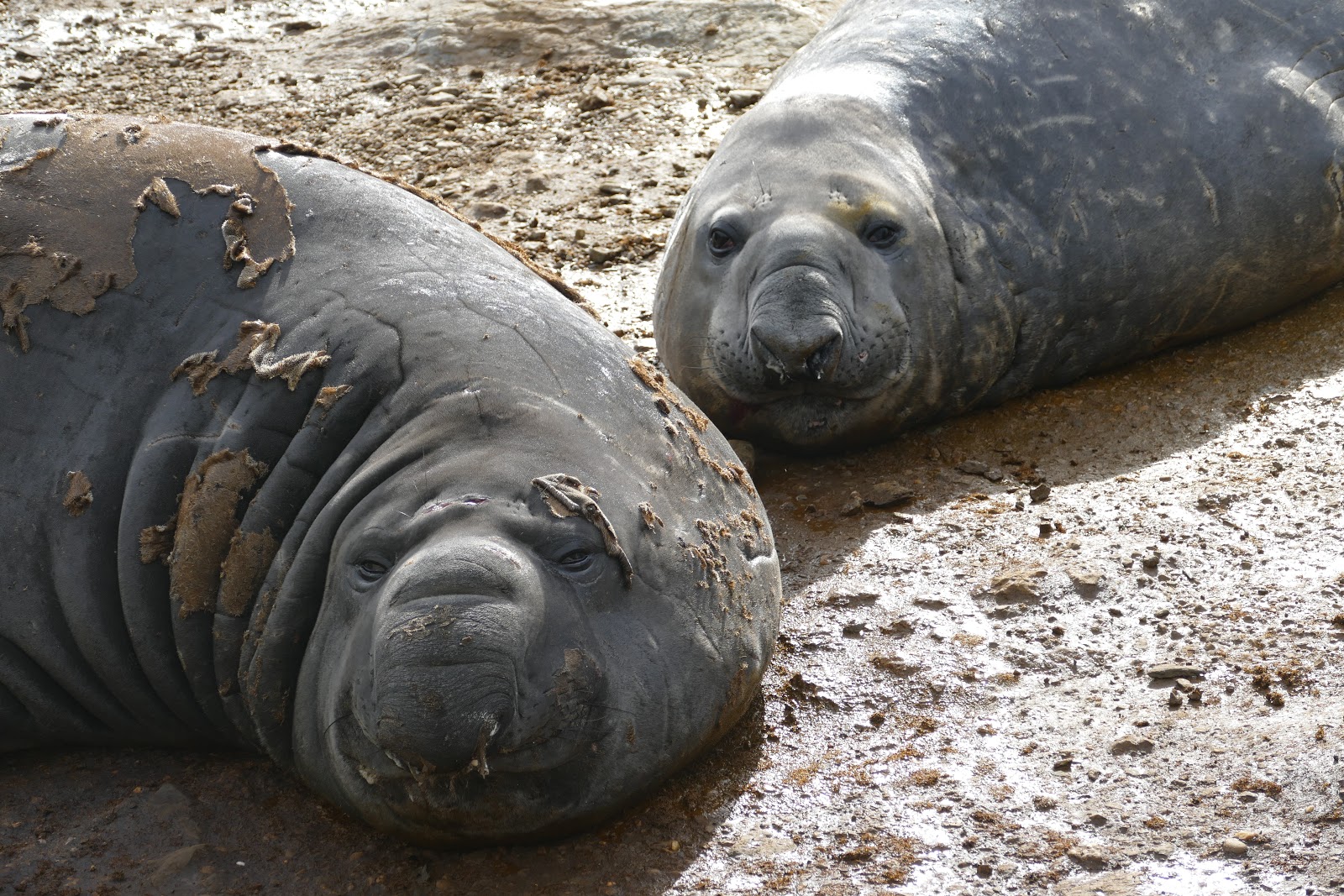
Elephant seals hang around the base itself, sitting alongside, or even on, all the walkways
My best view of a weddell seal as one came ashore just a little away from the ellies
It was amazing to still see so much wildlife; after how incredible BI was it is hard to imagine anything else matching up to it, but Signy does just that and I hope to have an opportunity to work here sometime in the future. But until such a day comes, it has been a privilege to see it now and enjoy the wildlife on offer.
We visited a number of chinstrap colonies, in total there were hundreds, even a couple thousand, of them :)
Not a bad view for these chinnies to have from their colony
We've seen the occasional chinstrap on BI, but being in a colony was incredible
As ever, penguins are just entertaining to sit and watch
There is always one that more feisty than any others!
Time to get artistic with black and white photos of black and white penguins!
At this time of year the chinstraps, like gentoos and macs, are around to moult
It was great to be able to sit and enjoy the sites of another station
They are a very smart looking species
Just chilling out
The scale of the animals we have worked and lived with really hits home at moments like this
So many seals you can't even see the beach, these were all males!
They do seem to enjoy laying around together and moulting...
...but the occasional squabble occurs with individuals rearing up at each other
Signy is within the Antarctic circle itself so having to cross a glacier to get to work is a regular position for the scientists on base, but for those of us from BI whilst very deep snow and thick ice may be often experienced a glacier was certainly something new!
No picture I could take will do it justice - but glaciers are amazing!
With the sky and the ground pretty much the same colour you can see how in worse weather conditions you could get disorientated on this sort of terrain, BAS make sure all staff are fully trained for such circumstances
An interesting way to walk to work
At the end of the glacier a beach full of elephant seals and a chinstrap penguin colony around the corner - brilliant!
Leaving Signy marked the end of my time as an Antarctic research scientist but luckily it didn’t mark the end of my travels home as Lucy, James and I had arranged to investigate the Falklands and Ascension on the way back. But it is goodbye to BI, BAS and the Antarctic…………. for now!