Showing posts with label Snow. Show all posts

Monday, 24 December 2018

Living on an Antarctic Island

The British Antarctic Survey have five permanent bases; Halley on the continent, Rothera on the Peninsula, King Edward Point on South Georgia and neighbouring Bird Island on - you guessed it - Bird Island. The fifth and smallest of the stations, Signy on Signy Island in the South Orkneys, is my home this austral summer and whilst I recommend taking a virtual tour of the station I'll do my best to describe it, and what life is like in it, as well.
Signy Station
Signy is home to a maximum of 8 people each summer - this year we have 7 in total - and the team is typically made up of 4 regular positions and up to 4 alternating roles depending on the works going on each particular season. The four regular roles are: Station Leader, Facilities Technician, Field Assistant and Zoological Field Assistant; and this year we have two Carpenters and one Visiting Scientist with us as well. There is plenty happening at Signy this year; the fieldwork is as busy as ever monitoring the penguins, seals, shags and giant petrels whilst at base there is plenty to do with the station undergoing a refurbishment with new doors, floors and paintwork and the field huts are being modified as well - Busy Times!
Back L-R: Me (Zoological Field Assiatnt), Fabrizio (Scientist studying Chinstraps), Matt (Station Leader/Carpenter), Ali (Field Assistant), Iain (Facilities Engineer), Elephant Seal (local layabout)
Front L-R: Tom (Carpenter) and Jim (Carpenter); (photo courtesy of Iain)
The base itself has changed somewhat since it was originally built in the mid-1940's. With the change from a wintering station to that of a summer only one in the late 1990's the profile of Signy has changed considerably.
Photos of the old stations in our corridor
The base itself is comfortable but smaller than my previous home of Bird Island. The main building houses our labs, offices, living room, kitchen, bootroom, bathroom and toilets, medical room, boilers and the bedrooms (invariably called bunkrooms or pit rooms).
The main building, SΓΈrlle House, with a remnant from a, fortunately, bygone era out front - a boiler from a whaling ship dating from around the 1920's, the cetacean populations are still very much struggling and barely beginning to recover in most cases
The pit rooms are rather small but enough for us to store all our stuff. There is something strange about still using bunk beds for a team of people in their 30's to 50's but it becomes quite a usual thing when working on small, remote islands to save space.
Bunk beds - the grown-up way to sleep
Of course the wildlife is never far away, with penguins and seals often coming ashore and making it known they are here early in the morning outside the bedroom windows!
Noisy neighbours, a couple of elephant seals under my bedroom window
The kitchen is ideal for cooking the meals for a small team and there is a pantry to store some foodstuffs so that we just restock this room when needed from the main food stores in another building. This means we don't have to go outside every time we need an extra couple of eggs!
The kitchen and pantry at the end
The living room is comfortable for 7-8 people and is great for setting up the projector and watching a movie in the evenings, playing darts and generally chilling out. It also serves as our dining room with tables wheeled in and out each evening for our meal. Of course at this time of year the living room gets a seasonal upgrade!
Iiiiiiiiit's Chriiiiiiistmaaaaaaaaaaaaas!!
The other rooms all serve the purpose for which they were built very well, with refurbishment going on this year there are quite a lot of building materials about which isn't usual. But the labs, offices, bootroom and bathrooms are all very much like Bird Island, just that bit smaller but very familiar.
Bootroom, heated to dry out all our field clothing each day
Shower - looking like some sort of metal bunker!
My lab/office, and temporary home to some of the seasons building supplies
The other buildings on station are: the generator shed and RO plant room (reverse osmosis for water collection); the fuel farm (storage of our fuel for the season); haz-store (safe storage of hazardous substances, such as chemicals for scientific sampling, paints and cleaning products); and top-store where waste management is sorted, tools and equipment are stored, chippy work can be carried out and next-door all the food is stored.
The combined workshop, field equipment store and waste management area
Our store of dried food, with three large freezers and one large fridge in the next room for all our meat, vegetables, fruit, cheese, ice cream and other bits and pieces
Although quite isolated here at Signy we do get visitors! Cruise ships can schedule visits here and we have four set-up for this season, the first of which came back on the 8th December.
Our usual visitors, the elephant seals, aren't bothered about the new visitors
The Barque Europa is a very interesting way to travel the Southern Ocean with it's three masts it looks more like something out of history than current Antarctic sailing. But this is the experience the visitors pay for, and quite an experience they get! not just a tour of Antarctica but also required to help out on the ship, keeping it clean and learning the ropes - quite literally!
Barque Europa
Sometimes the best ways to travel and explore are to get fully involved with the entire experience.
For the visitors, learning to help sail means learning some of the rope systems on deck!
Of course. the highlight for the visiting ships are to come ashore, see what life is like on base, talk to our staff about what we do, how we do it and what experiences we have had; plus the inevitable shopping for souvenirs!
Visitors enjoy their shopping
It is not just the occasional visit of a cruise ship that keeps the isolated feeling to a minimum here. Communications with the outside world are very good by phone (we have a British landline!) and decent enough by the internet. But we are also in regular contact with the other stations, particularly the islands for whom the similar living conditions mean we have a lot in common. We have annual competitions with the other bases, in particular darts matches. This year we have already played, and lost to, Bird Island, a fact they will not let us forget anytime soon!
Oooone-hundreeed and eeeeiighty!! (If only!)
Life on an Antarctic Research Station can feel isolated and extreme. But when you have a great team, comfortable surroundings and incredible wildlife it very quickly feels like home! This year all 7 of us have worked on at least one BAS station before at least once, so it is all very familiar and yet very different at the same time. It is this mixture of the familiar and the new that keeps us all excited and interested to work here again!

For more great photos and information on what it is like here at Signy then check out Ali's blog as well, he is a much better photographer than I am!

Friday, 14 December 2018

Wonderful Weddells

Gourlay, the main study site here on Signy, is not just home to the Adelie and Chinstrap penguins but is also a popular spot for seals to haul out. We have had a Leopard Seal and regular appearances by Fur Seals, but the one I have particularly enjoyed recently are the Weddell Seals.
A Weddell chills out on the snow with a Fur Seal and Adelies on the rocks
The Weddells provide a lot of entertainment for us, despite often just lying there, as it is the reaction of the penguins wondering how best to walk around them that makes us smile.
With a seal in the way the penguins take a while to decide which way to go next
For the most part the seals are just relaxing, digesting their recent meals from out at sea, and getting some peaceful sleep.
Enjoying some warmth from the sun whilst relaxing
It's a hard life being a seal!
Occasionally they stir themselves to look around and have a bit of a scratch. But it is never long until they go back to sleep again.
Scratching away that annoying itch!
Weddells don't just appear one at a time though, sometimes there are small groups of them hanging out in a favoured spot.
5 Weddells all in the same bay at Gourlay
The most we have seen at one time, so far, is 6 with one of these being a weiner. This is a pup that has now left its mother and is learning to fend for itself. But that doesn't mean it can't also learn how to sleep!
A weiner chills out with some adults in the background
The weiner has actually popped up a number of times over a few weeks in places all around the island, evidently getting acquainted with Signy and finding preferred spots to haul out at.
Small, slightly furry still having not shed all its pup fur, but still impressive to see
Sometimes you just have to wonder, are they dreaming? And what of?
That typical tired look of a kid just waking up that wants to stay in bed!
My favourite moment had to be when the weiner decided to visit us on base. Hauling out just next to the main building here it stuck around for a little while and then left. But when it came back it decided hauling out was too much effort and sleeping in the tide line was a good enough option!
Relaxing in the calming rocking off the waves on the shoreline
The Weddells are fairly frequently seen in small numbers through most of the season, so hopefully we get to spend quite a bit more time with such charismatic seals!

Monday, 10 December 2018

Adelie Life

The Adelie season is progressing well here at Signy and is now reaching an important stage as all the chicks are hatching. We monitor one colony regularly, every 2-3 days, to ascertain how well the season is progressing and use data collected from this site to determine when is the optimum time to visit other colonies where more periodical checks are carried out.
The colonies are very active at this time of year
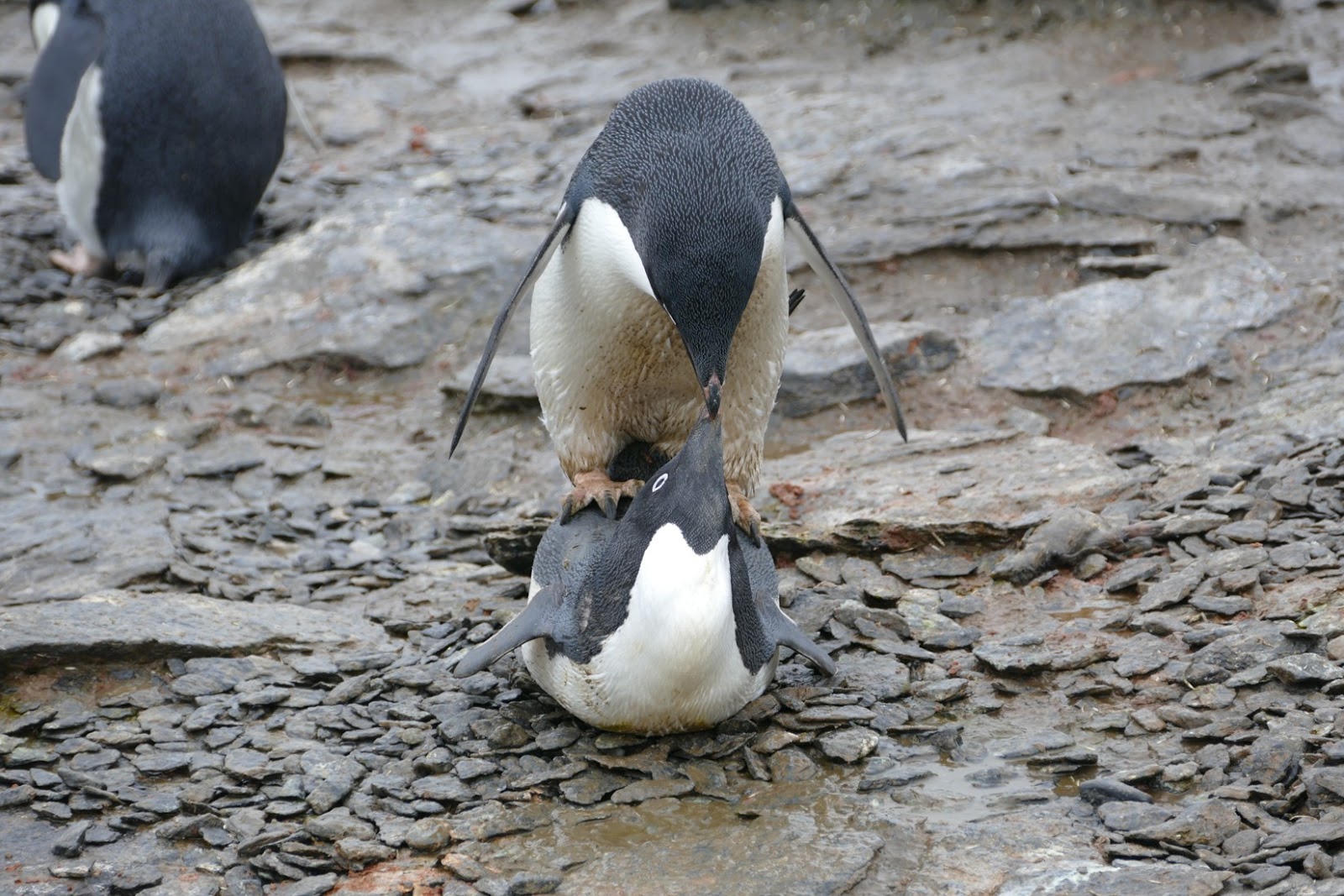
Although the chicks are hatching the colony is still a mixture of nests at different stages. Those nests that laid late are still on eggs whilst those that are very late, or maybe failed and are trying again, are still pair bonding and mating.
Mating pair of Adelies
Although there is a mixture of breeding stages within the colony, as there always is in most seabird colonies, the vast majority have reached that exciting time - hatching!
Known as pipping, the chicks first break through the egg creating a small hole with the 'egg tooth' on the end of their beaks
Once hatched the chicks are well guarded by the adults, who take it in turn to incubate eggs and brood chicks. As the chicks are so small we often see nothing more than a small patch of grey fluff under the brooding adult.
First glimpses of chicks can be very brief
When switching brooding duty the two parents will call to each other to reaffirm pair bonds before the adult that was brooding takes a turn at foraging to bring food back to the new chicks, and vice versa.
Adults call to each other when reunited at the colony
Once hatching begins the rate of hatching continues to increase, in just a couple of weeks we go from the first chick to hundreds of them and we can begin to see grey fluff sticking out of most of the nests.
Chicks are appearing in more and more nests each day
Of course, once hatched the chicks are very interested in food! These feeding times give us the best opportunity to see the chicks more clearly as they beg for food and get fed by adults regurgitating small amounts of crustaceans (normally krill) or fish at a time.
A young chick gets a feed
It doesn't take long for the chicks to begin growing and become more boisterous and demanding on the nest. Adelies lay two eggs, and in good conditions can raise both chicks through the season.
One chick gets fed as the second pokes its beak out
The chicks continue to grow and start to become too big to be entirely covered by the brooding adult. At this stage the chicks can regularly be seen but are not yet big enough to be left unguarded by the adults.
Happy families
As with any ecosystem, when there is a source of food there will be something to eat it. Penguin colonies, with all the nutritious eggs and helpless young chicks available, attract attention from Skuas. Brown Skuas can often be seen harassing nests from one side causing the adult penguin to shift that way to guard the nest, this allows a partner bird to sneak in and take an exposed egg or chick from the other side. It is brilliant to see nature at work and in balance like this.
Skuas often hang around the edge of penguin colonies, looking for opportunities to feed
Of course Skuas aren't the only predators on the colony. Penguins themselves are predators, eating krill, other crustaceans and fish to survive and raise their chicks. But when all is calm in the colony there aren't many better sights than penguins!
A serene moment for this incubating adult
We very much enjoy our work here at Signy and occasionally the sun will come out and allow us to enjoy the views over a tea break!
The huts at Gourlay allow a great place to store equipment and have a break during the working day
Not to be forgotten though, the penguins will make sure we are always aware they are here!
An Adelie comes to check out the huts
Gourlay is our main site for studying the Adelies and Chinstraps, but they and the Skuas are not the only species present. Seals are often seen in the bays and Snowy Sheathbills are always flying around looking for scraps of food. But the highlight at the moment from the other species is the noise of Wilson's Storm-Petrels calling from their nest sites under rocks and in crevices between the stones.
Very hard to see as the nest sites are quite deep, occasionally we can glimpse a Storm-Petrel or two in the rocks
With the Adelies progressing so quickly it won't be long until the chicks are big enough to be left unguarded by the adults. At this stage the chicks will creche together in large huddles for warmth and safety, but until then there are plenty more to hatch!

Monday, 3 December 2018

Views of Signy

Although I am working with the wildlife on Signy the island itself is something to appreciate as well. At about 7km at its longest by 5km at its widest the island is still a small one - although bigger than my previous home of Bird Island - but manages to fit in a whole range of landscape views that are quite incredible. The profile of Signy is highly variable with lots of moss banks, scree slopes, cliff faces and a glacier in the middle each time we visit a different area we get a completely different view of the island. Despite the fact that photos cannot truly show the scale and majesty of such a location I have got to try; so here are some examples of the landscape we are fortunate enough to work in:
The view from the base itself is a great way to start each day, looking over to Coronation Island
After climbing up the stonechute from base we reach the main path to the glacier, this path overlooks Shallow Bay (which is crossable on low-tide) and the almost ever present Coronation Island is very impressive across the sea
The McLeod Glacier quickly comes in to view, as does the snow that has heaped on top of it over the winter, snow that is now starting to fall away more each day
The main path from base to the glacier runs across the side of scree slopes that themselves offer something interesting to the landscape
The most frequented path is that which runs from the bottom of the glacier down towards Gourlay, the most regularly visited study colony; often the views out across towards Gourlay and the Oliphant Islands are surrounded by icebergs
Gourlay itself also has some amazing views, just from the hut across Rock Haven - a popular spot for seals as well as penguins
Of course the views from Gourlay across to the Oliphant Islands can't help but include the penguins
One of the larger Adelie colonies always adds to the impressive views
Looking out from Snow Hills, a peak of 265m, out towards North Point with Coronation Island in the background
Not a bad place to work, checking the VHF Repeater on the top of Snow Hills
Cummings Cove as seen from one of the field huts, pretty nice to wake up to when out in the field overnight!
Cummings is visited when monitoring the Chinstrap colonies, including this one that looks out across Moyes Corrie towards Moe Island
Each new location offers more great views, such as this view across Port Jebsen to Everson Ridge
Of course, the sun isn't always shining on Signy, in fact that is a bit of a rarity. More often we have grey skies, dark and ominous clouds on the horizon and snowfall. That doesn't make the scenery any less spectacular, in fact it more often than not adds to the spectacle of the place. But when the cloud rolls in over the icecap causing white-out conditions the views become considerably less spectacular!
Tioga Hill, at 278m the highest peak on Signy and some of the most spectacular views we get..... sometimes!