Sunday, 23 April 2017

The Journey Home - Part 3: Falklands

The RRS Ernest Shackleton got in to the Falklands on the 25th March, bringing me back out of the Antarctic territories for the first time in 499days! What a journey, what a job, what an experience!! But that wasn’t the end as Lucy, James and I arranged to stay and investigate what the Falklands has to offer and we were rewarded by some great sights and some brilliant people.
A Falkland thrush
Stanley is the main town on West Falklands and we stayed there for the first few days enjoying our first retail therapy in a long time! We also checked out the local wildlife, and wow was it impressive! The highlight was a day when James went to find dolphins whilst Luce and I went to see a rockhopper penguin colony. It was brilliant to see a new species of penguin for us, and to see so many jumping around at impressive speed was a spectacular sight.
A new colony, a new species for us, it was great to see the rockhoppers!
Looking across the rockhopper colony
Some of them looked really smart, others really scruffy, the perils of the moulting season!
Funky little penguins
They pair up still, bonding at the end of the season
Even in a visit for just a couple hours we could see what characters these guys are
That hairstyle is very striking
As with all the penguins I have been lucky enough to see and work with, the rockhoppers are just amazing to watch
After such sights from our time in Stanley it would be hard to get better, but we did just that! Going to stay at a lovely little cottage at Elephant Beach Farm and investigating around Cape Dolphin gave us so much! Penguins, vultures and other birds, sea lions, dolphins and whales. If anyone ever goes through the Falklands then this is the place to have a weekend away at, whilst no photos could do this part of the trip justice I’m going to try:
Rock shags
Night heron
Kelp gulls on the beach
A dolphin gull decides to test if seaweed is food, in this case it isn't!
Steamer ducks going for a paddle
Steamer ducks have flightless and flying variations, these ones were flightless
Who made those tracks in the sand?...
...gentoos! These guys are everywhere but I never tire of seeing them :)
What makes these burrows on the Falklands?...
...it's penguins!! Magellanic penguins to be precise
Nesting underground protects the eggs and chicks from aerial predators
Magellanics are sweet little penguins
There is something strange about seeing penguins popping out of the ground in fields full of geese
A different type of lion safari - a sea lion safari!
Sea lions are great to see, certainly very big and the males in particular look bear or lion like with that coat
Some of the big old guys are calm at this time of year, but earlier in the breeding season are very territorial
Just having a scratch...
...and a yawn, showing off those big teeth!
Quite different to fur seals, these sea lions were a huge bonus for us to be able to see on the way home
A group of females hangs out on the rocky shore
At this time of year many females are still raising their pups...
...pups that are just as cute...
...playful...
...and lazy as the fur seal pups that we are used to!
Peale's dolphins; unfortunately the sei whales were too far away for me to photograph, but seeing these dolphins closer in to shore looking for food in the shallows was brilliant
Turkey vultures are a regular sight, patrolling the skies
An adult resting with a youngster taking off in the background
Vultures can also be seen hanging out around colonies of penguins...
...sea lions colonies...
...and shag colonies, all to scavenge any scraps of food
It is great to see large birds of prey again
Red-backed hawk
Striated caracara
Barn owls have made it to the Falklands, most likely by roosting on ships
This terrain is not the same as the giant petrel study area on BI...
...but that doesn't mean I can't see a few of my study species one last time :) a small colony of southern geeps has taken to Cape Dolphin as a nesting site
A few weeks away from fledging still, but the wings are getting a workout

The Journey Home - Part 2: Signy

After visiting the neighbours at KEP it was on to Signy station on the South Orkneys for another few days seeing a different BAS base. I had briefly visited Signy on my way south, but on this occasion we were on the station for a longer time and I got the opportunity to look around quite a bit more.
Signy station
Signy is a summer only station, meaning it has to be closed down and everything stored for the winter. This takes a bit of time and with other works ongoing there was plenty to do around station getting everything sorted. But around that there were some opportunities to see more of the island itself.
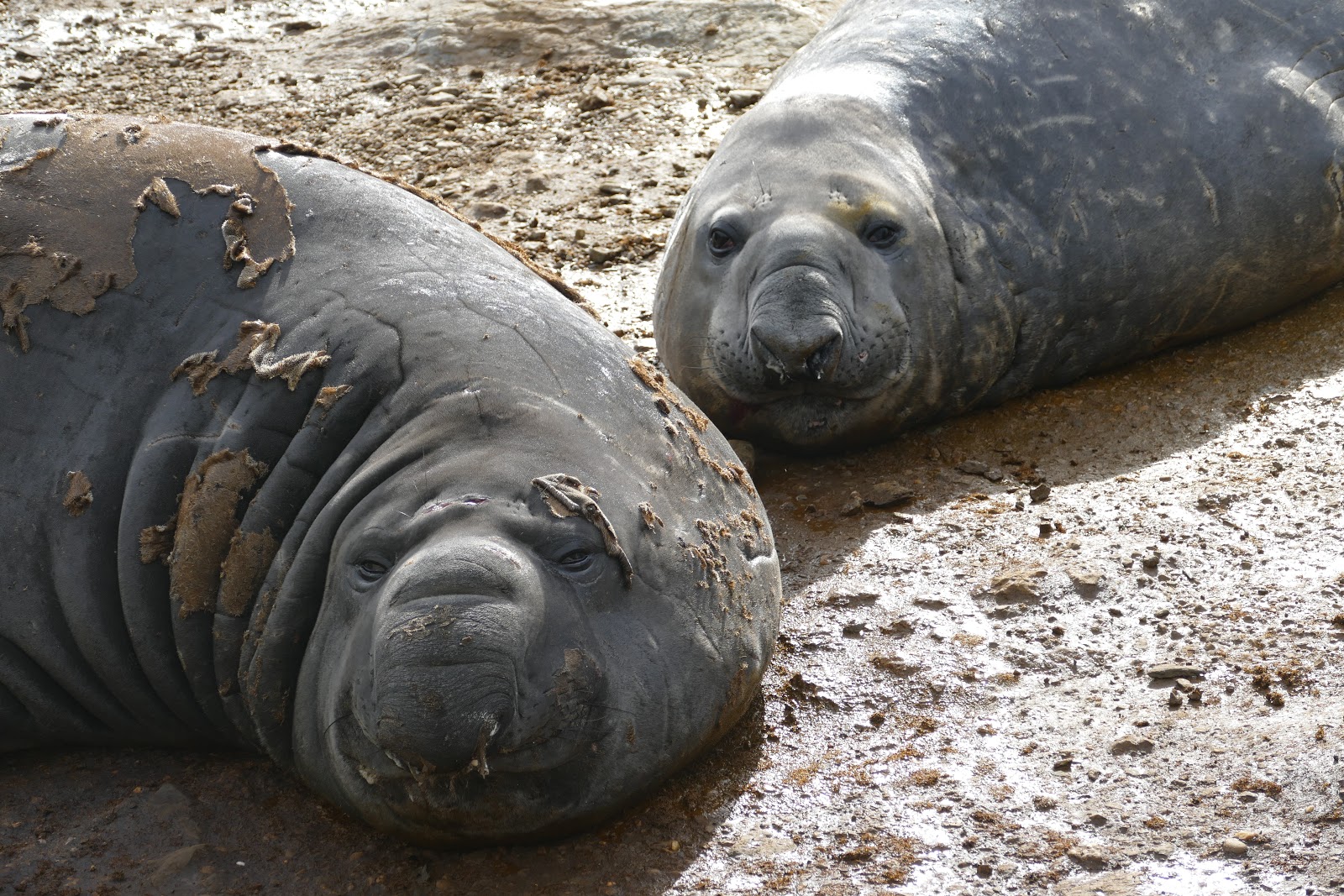
Elephant seals hang around the base itself, sitting alongside, or even on, all the walkways
My best view of a weddell seal as one came ashore just a little away from the ellies
It was amazing to still see so much wildlife; after how incredible BI was it is hard to imagine anything else matching up to it, but Signy does just that and I hope to have an opportunity to work here sometime in the future. But until such a day comes, it has been a privilege to see it now and enjoy the wildlife on offer.
We visited a number of chinstrap colonies, in total there were hundreds, even a couple thousand, of them :)
Not a bad view for these chinnies to have from their colony
We've seen the occasional chinstrap on BI, but being in a colony was incredible
As ever, penguins are just entertaining to sit and watch
There is always one that more feisty than any others!
Time to get artistic with black and white photos of black and white penguins!
At this time of year the chinstraps, like gentoos and macs, are around to moult
It was great to be able to sit and enjoy the sites of another station
They are a very smart looking species
Just chilling out
The scale of the animals we have worked and lived with really hits home at moments like this
So many seals you can't even see the beach, these were all males!
They do seem to enjoy laying around together and moulting...
...but the occasional squabble occurs with individuals rearing up at each other
Signy is within the Antarctic circle itself so having to cross a glacier to get to work is a regular position for the scientists on base, but for those of us from BI whilst very deep snow and thick ice may be often experienced a glacier was certainly something new!
No picture I could take will do it justice - but glaciers are amazing!
With the sky and the ground pretty much the same colour you can see how in worse weather conditions you could get disorientated on this sort of terrain, BAS make sure all staff are fully trained for such circumstances
An interesting way to walk to work
At the end of the glacier a beach full of elephant seals and a chinstrap penguin colony around the corner - brilliant!
Leaving Signy marked the end of my time as an Antarctic research scientist but luckily it didn’t mark the end of my travels home as Lucy, James and I had arranged to investigate the Falklands and Ascension on the way back. But it is goodbye to BI, BAS and the Antarctic…………. for now!

The Journey Home - Part 1: King Edward Point

Leaving a BAS research station is a weird feeling. Having called such an incredible location home for 16 months leaving Bird Island is difficult, but I will always remember it with amazing memories. But my journey didn’t just end there. Due to the movements of the RRS Ernest Shackleton I was fortunate to be able to travel back home via Signy (South Orkneys) and first, King Edward Point (South Georgia)!
The Shack moored up alongside KEP
KEP is the closest neighbour we have on BI, but even they feel a million miles away when we are on station, so it was nice to finally see what it is like ‘around the corner’.
A few large elephant seals were ashore moulting to welcome us to KEP
In spending a few days on station it was nice to be able to see around the place, particularly when going out and investigating the field sites that the KEP scientists work at. One location I had heard about was Maiviken where the fur seals are monitored. At this time of year most of the adults are out at sea but it was brilliant to have some more time with pups, playing around in their very own lake.
Puppy lake...
...a fun place to watch curious fur seal pups swimming around
I'm certainly going to miss seeing these faces every day!
Very curious puppy!
Blonde pup! It was great to see a blondie one more time
Aside from the seals though I knew KEP was also a great place to see penguins. Having worked with so many macs and gentoos on BI it was nice to continue seeing the latter in small colonies around KEP. But the highlight was finally getting to see king penguins at the nest! Whilst it was a quiet time of year for these as well there is a location called Penguin River where there were a handful of kings still nesting and I got my first sighting of their chicks!
A few small groups of gentoos were around to remind me of my study species
Penguin river
The only 5 king penguins I have seen brooding chicks...
...but seeing even just 1 is amazing!
A few neighbourly squabbles occur in the colony
The chicks are still small and being brooded
Whilst it was nice to still see all the wildlife, where South Georgia really excelled in such a short visit is the scenery! I was used to BI where everything is at most an hour away and walking to Maiviken alone takes 2 hours on South Georgia. This increase in scale also relates to the scenery and South Georgia, with glaciers and snow capped mountains to see, is definitely quite a spectacle.
The scenery around South Georgia, this on the way to Maiviken, is stunning
Walking through the snow was a reminder of what we will be leaving behind!
This is something BI doesn't have, so it is great to get the extra experience
A trip out on a harbour patrol vessel to drop off supplies to a field team and see a glacier up close - yes please!
A blurry storm petrel feeds around the glacier
Scientists are just the latest people to come to South Georgia though. When whaling was a big global industry South Georgia had its own processing sites, one such location is Grytviken where much of the infrastructure can still be seen today.
The view of Grytviken (left), the cemetery (lower middle) and King Edward Point (upper middle)
Grytviken - an old whaling station, now a museum for tourists
The church at Grytviken is still active on South Georgia, with occasional ceremonies taking place
A few old whaling vessels can still be seen at Grytviken
A wrecked ship makes a great pool for puppies to play in!
Going back even further South Georgia is the site of Shackleton’s famous expedition, and it is his final resting place today. I can’t even begin to imagine how different it would’ve been to come to the Antarctic in those days and it makes me feel very grateful that early explorers came here and opened up the pathways for all Antarctic scientists of today to be able to carry out such important research!
The cemetery on South Georgia...
...containing Ernest Shackleton's grave